
What is BitNetChain? A Complete Overview of the Next-Gen Blockchain Platform
BitNetChain is a next-generation blockchain platform that solves major issues like high fees and slow transactions, making it easy to use for both beginners and experienced users alike.
1.1. What You’ll Learn
- What BitNetChain is and how it works
- Key differences that set BitNetChain apart
- Real-world use cases for BitNetChain
- Key concepts explained in simple terms
- How BitNetChain operates
- Why you should choose BitNetChain
1.2. What is BitNetChain?
BitNetChain is a powerful blockchain platform designed to solve some of the most common challenges in the crypto space, such as high transaction fees, slow transaction speeds, and lack of scalability. In simple terms, it’s a blockchain that makes sending and receiving digital currency faster, cheaper, and easier.
Think of it like a highway for digital transactions—BitNetChain allows transactions to move quickly without traffic jams (like slow speeds or high costs). Whether you’re a beginner or someone already familiar with crypto, BitNetChain helps you use the blockchain more efficiently.
1.3. Why is BitNetChain Different?
What sets BitNetChain apart from other blockchains is its ability to handle a large number of transactions per second without increasing the cost. Most blockchains, like Bitcoin and Ethereum, can become slow and expensive when too many people are using them at once. But BitNetChain’s technology allows it to scale without compromising speed or increasing fees.
Here are a few reasons why BitNetChain is unique:
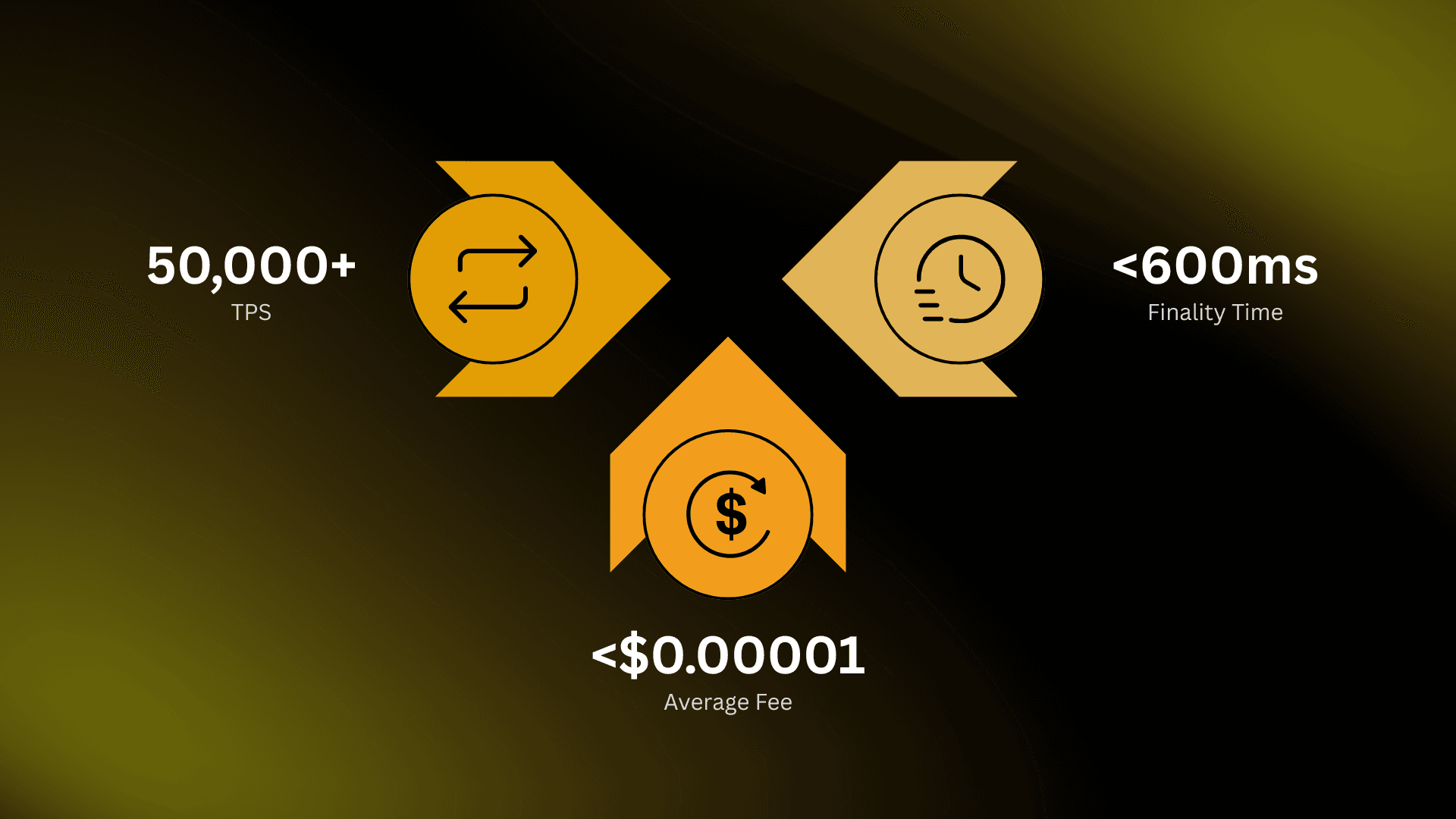
Speed, low fees, and strong security make BitNetChain truly different
- Speed: BitNetChain can process over 50,000 transactions per second.
- Low Fees: You can send money or interact with decentralized apps without worrying about high fees.
- Security: The platform is built to keep transactions secure and private, ensuring your digital assets are protected.
1.4. What Can You Do with BitNetChain?
BitNetChain is designed for everyday users and businesses looking for faster, cheaper ways to use blockchain technology. Here’s what you can do with it:
- Send and Receive Money Fast: BitNetChain’s low fees make it a great option for sending money across the world. Whether you’re transferring to friends or family, you’ll save on fees compared to traditional financial systems.
- Access Decentralized Finance (DeFi): You can use BitNetChain to access a wide range of decentralized financial services, like lending, borrowing, and trading—all without needing a middleman (like a bank).
- Tokenize Real-World Assets: BitNetChain allows you to convert real-world assets, such as real estate or stocks, into digital tokens. This makes investing more accessible and gives people the chance to own a piece of high-value assets.
- Staking and Earning Rewards: By participating in BitNetChain’s staking system, you can earn rewards simply by helping to secure the network. This is a great way to passively grow your crypto holdings.
1.5. Key Concepts Explained
Here are some important concepts related to BitNetChain, explained in simple terms:
- Blockchain: A digital ledger that records transactions across multiple computers. It’s decentralized, meaning no one person or entity controls it.
- Staking: By holding and "staking" your BitNetChain coins, you can earn rewards and help keep the network secure.
- DeFi: Short for decentralized finance, which means accessing financial services like lending, borrowing, and trading without traditional banks.
- Tokenization: Turning real-world assets (like real estate or stocks) into digital tokens on the blockchain, making them easier to trade and own fractionally.
1.6. How Does BitNetChain Work?
BitNetChain works by using a unique consensus mechanism called Proof of Stake (PoS), which ensures that transactions are verified by users who have staked coins to help secure the network. Unlike traditional Proof of Work (PoW) systems, which require heavy computer processing power, PoS is more energy-efficient and faster.
Additionally, BitNetChain uses a technology called dynamic sharding. Think of it like splitting a large job into smaller tasks. This allows BitNetChain to handle many transactions at once, making it much faster than other blockchains that handle transactions one by one.
1.7. Why Choose BitNetChain?
Here’s why BitNetChain could be a good choice for your digital transactions:
- Affordable: You can send money, trade, and use apps without paying high fees.
- Fast: Transactions happen quickly, so you don’t have to wait long for your payment to go through.
- Secure: BitNetChain’s security features, like staking and encryption, keep your assets safe.
- Access to DeFi and RWA: Whether you're looking to invest, stake, or participate in decentralized finance, BitNetChain offers a variety of options.
1.8. FAQ
Do I need technical knowledge to use BitNetChain?
No! BitNetChain is designed to be user-friendly. You can start using it with minimal technical knowledge, whether you’re sending crypto to someone or staking to earn rewards.
How do I get started with BitNetChain?
First, you’ll need a BitNetChain wallet. From there, you can send and receive crypto, stake your coins, or explore DeFi applications.
What’s the benefit of staking?
Staking allows you to earn rewards while helping to secure the network. It’s a great way to make your crypto work for you.
1.9. Conclusion
BitNetChain offers a fast, affordable, and secure solution to common blockchain problems like high fees and slow transactions. Whether you're a beginner or experienced crypto user, BitNetChain makes it easy to send and receive crypto, invest in tokenized real-world assets, or participate in DeFi. With its innovative technology and user-friendly design, BitNetChain is positioning itself as a leader in the blockchain space, providing real-world solutions for both everyday users and businesses.
BitNet Coin (BNC) Overview and Its Role in the BitNetChain Ecosystem
BitNet Coin (BNC) is the native cryptocurrency of the BitNetChain ecosystem. Learn how BNC fuels the network, powers transactions, and supports decentralized governance.
2.1. What You'll Learn
- Introduction to BitNet Coin (BNC)
- Key functions and uses of BNC
- The role of BNC in transaction fees, staking, and governance
- BNC tokenomics and deflationary features
- How to earn rewards with BNC
- The importance of BNC in BitNetChain's ecosystem
- Future potential and developments
2.2. What is BitNet Coin (BNC)?
BitNet Coin (BNC) is the native cryptocurrency that powers the BitNetChain ecosystem. It is integral to the network’s functionality, allowing users to participate in governance, secure the network through staking, and pay for transaction fees. As a deflationary token, BNC has been designed to maintain its value over time, ensuring the long-term sustainability of the ecosystem.
In simple terms, BNC is the lifeblood of BitNetChain. Whether you’re making a transaction, staking your coins to earn rewards, or voting on important governance decisions, BNC is at the core of it all.
2.3. Key Functions and Uses of BNC
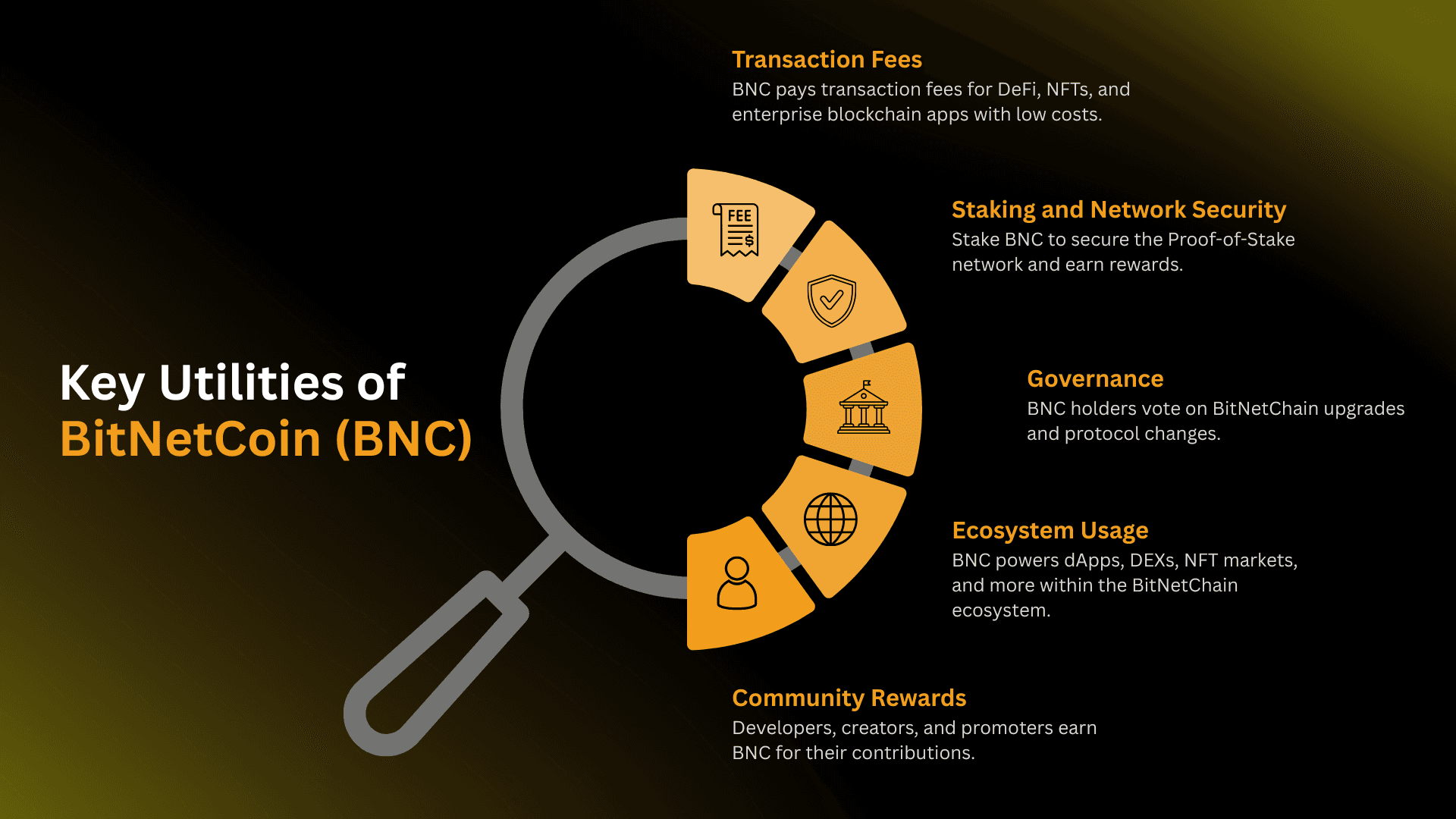
Key Functions and Uses of BNC: Transaction Fees, Staking and Network Security, Governance, Ecosystem Usage, and Community Rewards
2.3.1. Transaction Fees
BNC is used to pay transaction fees and interact with smart contracts across the BitNetChain mainnet and its application-specific subnets. The low-fee structure supports scalable DeFi, NFT platforms, and enterprise blockchain solutions, making it a highly affordable option for developers and users who require cost-effective blockchain solutions.
2.3.2. Staking and Network Security
To help secure the BitNetChain network, users can stake BNC and become validators or delegate their tokens to existing nodes. Stakers play an essential role in securing the Proof-of-Stake (PoS) consensus layer, earning protocol rewards in return. This process incentivizes honest participation, ensuring the network remains decentralized and secure.
2.3.3. Governance
BNC holders have voting rights to shape the future of the BitNetChain protocol. Through decentralized governance mechanisms, the community can vote on proposals, adjust network parameters, approve upgrades, and allocate ecosystem grants, empowering users to actively influence the development of the platform.
2.3.4. Ecosystem Usage
BNC fuels a rapidly expanding suite of decentralized applications (dApps) on BitNetChain, such as DEXs, NFT marketplaces, launchpads, and blockchain bridges. BNC serves as the core medium of exchange and collateral within BitNetChain’s modular financial layer, enabling seamless integration and interaction across the entire ecosystem.
2.3.5. Community Rewards
Active contributors—such as developers, creators, node operators, and ecosystem promoters—can earn BNC for their efforts. This incentivization model fosters grassroots innovation and encourages broad community engagement, ensuring the continued growth and success of the BitNetChain ecosystem.
2.4. BNC Tokenomics
BitNet Coin (BNC) is designed with a deflationary model to ensure long-term value retention. Here are some key aspects of BNC’s tokenomics:
- Fixed Supply: BNC has a capped supply of 21 billion coins, ensuring scarcity and protecting against inflation.
- Burn Mechanism: A portion of transaction fees is burned over time, reducing the overall supply of BNC and potentially increasing its value.
- Halving Events: Similar to Bitcoin, BNC undergoes halving events every 4 years, which reduces the block rewards for validators. This helps decrease inflation and increases scarcity, rewarding long-term token holders.
This deflationary structure is designed to create value for BNC holders as the platform grows and more people join the BitNetChain ecosystem.
BNC Tokenomics Overview
2.5. How to Earn Rewards with BNC
There are several ways to earn rewards through BNC:
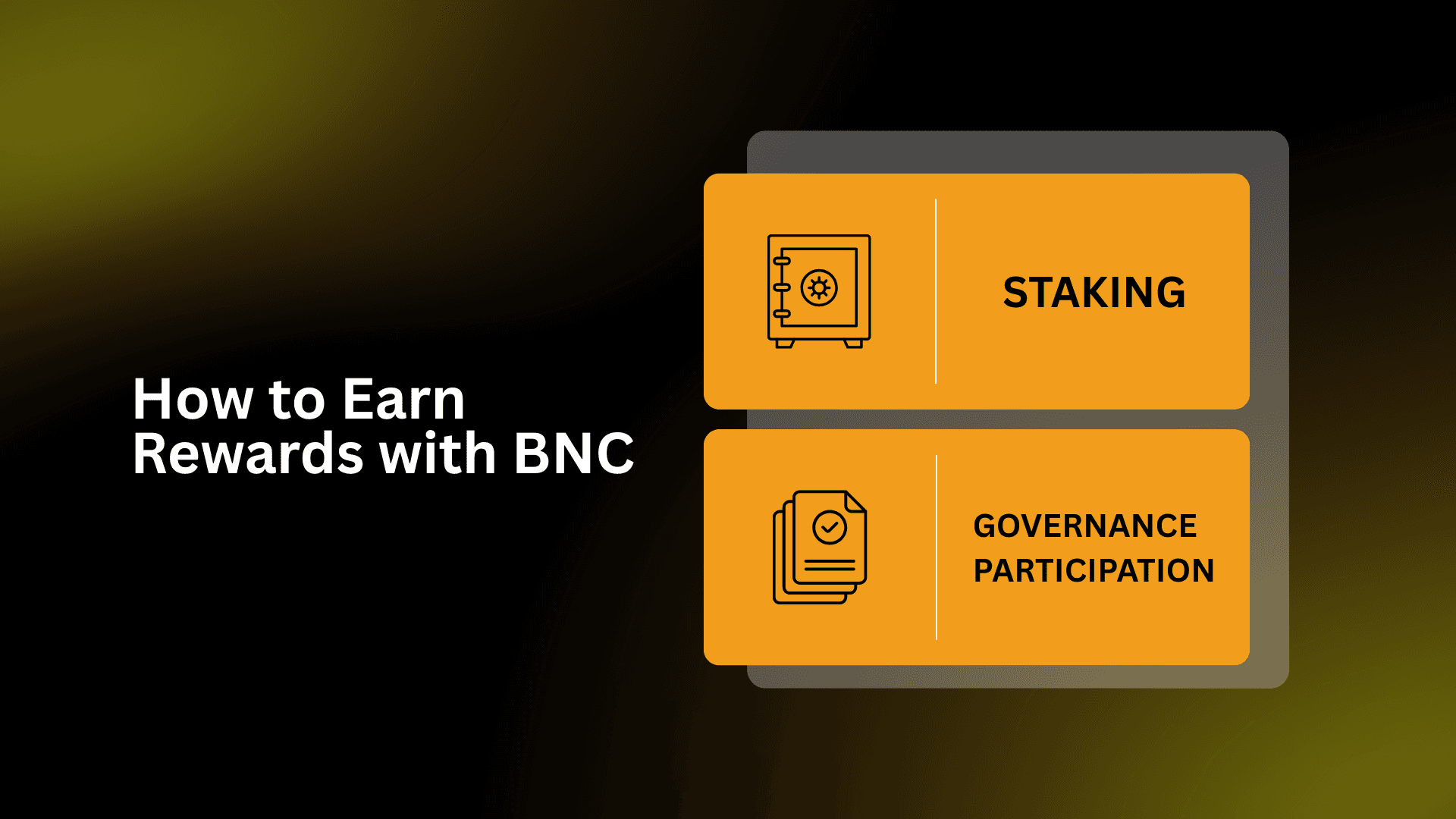
Two Ways to Earn BNC Rewards: Staking and Governance Participation
- Staking: The most common way to earn rewards with BNC is by staking it. When you stake your BNC, you contribute to the network’s security, and in return, you earn staking rewards. These rewards are distributed periodically and are based on the amount of BNC you’ve staked and the total amount of staked coins in the network.
- Governance Participation: Participating in governance by voting with your staked BNC can also yield rewards in some cases. By taking an active role in shaping the network’s future, you can earn a share of the rewards allocated to governance participants.
2.6. The Importance of BNC in the BitNetChain Ecosystem
BitNet Coin is more than just a cryptocurrency; it is the backbone of the entire BitNetChain ecosystem. Its utility goes beyond just transactions. Here's how BNC helps ensure the health of the ecosystem:
- Facilitates Fast, Low-Cost Transactions: BNC is used to pay for transaction fees, which are kept extremely low, ensuring that users don’t have to worry about expensive costs when using BitNetChain for everyday activities or DeFi applications.
- Secures the Network: BNC is crucial in the PoS consensus mechanism, where stakers lock their tokens to help validate transactions and secure the network.
- Decentralized Governance: BNC provides the community with the power to make decisions about the network’s future, ensuring a truly decentralized and user-driven platform.
2.7. The Future of BNC
As BitNetChain grows and expands, the demand for BitNet Coin (BNC) is likely to increase. The continuous improvements to the network, including enhanced scalability, interoperability, and integration with other blockchain ecosystems, will increase the demand for BNC as users and developers interact with the platform.
In the long term, BNC’s deflationary features (such as token burns and halving events) will likely contribute to its value growth. Additionally, as more users participate in staking and governance, BNC will play a central role in maintaining the security and decentralization of BitNetChain.
2.8. FAQ
How do I get started with BNC?
You can acquire BNC through various exchanges or directly from the BitNetChain platform. After obtaining BNC, you can store it in a BitNetChain wallet, stake it for rewards, or participate in governance. to someone or staking to earn rewards.
What is the benefit of staking BNC?
Staking BNC allows you to earn rewards while helping to secure the network. You can earn a passive income from your staked tokens and be part of the decision-making process on the platform.
Is BNC inflationary or deflationary?
BNC is designed to be deflationary. With a capped supply, regular burns, and halving events, BNC is structured to increase in value over time as the supply decreases.
2.9. Conclusion
BitNet Coin is more than just a cryptocurrency; it is the essential driving force behind the BitNetChain ecosystem. From paying for low-cost transactions to earning rewards through staking and governance, BNC plays a central role in ensuring the platform’s security, decentralization, and growth. As the BitNetChain platform evolves, BNC will continue to serve as the foundation for a new era in blockchain technology.
How BitNetChain Achieves Ultra-Low Fees for Real-World Blockchain Use
BitNetChain provides a scalable solution with ultra-low transaction fees, making it ideal for DeFi, NFTs, and everyday blockchain use. Discover how BitNetChain is transforming blockchain with its low-cost design.
3.1. What You'll Learn
- Introduction to BitNetChain’s ultra-low fees
- How BitNetChain keeps transaction fees low
- The role of low fees in blockchain adoption
- Key benefits of low fees for DeFi, NFTs, and microtransactions
- How BitNetChain’s low fees benefit developers and users
- The future of low-fee blockchain ecosystems
3.2. Understanding BitNetChain Transaction Fees
BitNetChain delivers one of the lowest transaction fee structures in the blockchain space, a critical advantage in an environment where many networks become expensive during high activity. Low fees unlock practical use cases such as DeFi, NFTs, gaming, and microtransactions—areas that cannot scale when costs fluctuate unpredictably.
By maintaining stable and predictable costs, BitNetChain creates an environment where users, developers, and businesses can operate efficiently and deploy dApps without worrying about gas spikes. This blog breaks down how BitNetChain keeps its fees minimal and why this design choice plays a central role in its growth.
3.3. How BitNetChain Achieves Ultra-Low Fees
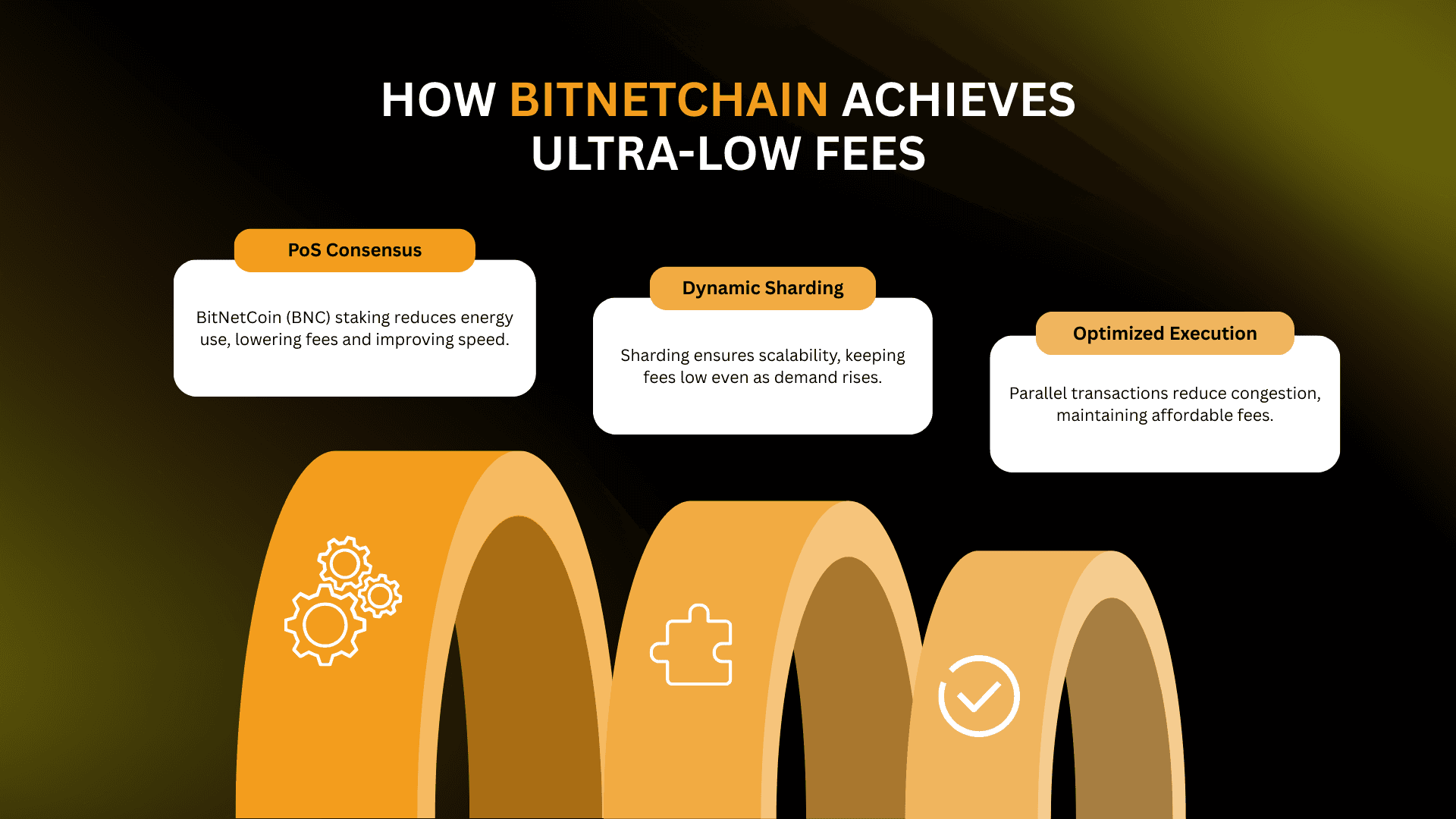
How BitNetChain Achieves Ultra-Low Fees: PoS Consensus, Dynamic Sharding for Scalability, and Optimized Transaction Execution
3.3.1. Proof-of-Stake (PoS) Consensus Mechanism
At the core of BitNetChain's low-fee model is the Proof-of-Stake (PoS) consensus mechanism. Unlike the energy-intensive Proof-of-Work (PoW) used by Bitcoin and Ethereum, PoS enables validators to secure the network by staking their BitNetCoin (BNC) tokens. This approach drastically reduces energy consumption, resulting in lower operational costs and, ultimately, more affordable transaction fees for users and developers.
By lowering the cost of transaction validation, PoS ensures that fees remain minimal while maintaining the security and integrity of the blockchain. Faster transaction validation improves overall efficiency, making the entire network more cost-effective.
3.3.2. Dynamic Sharding for Scalability
BitNetChain employs a technique known as dynamic sharding, which divides the network into smaller, manageable segments called “shards.” This allows the platform to process transactions simultaneously across different parts of the network. As the platform scales, the number of active shards adjusts dynamically, ensuring that the network remains efficient even during periods of high demand.
This scalable architecture allows BitNetChain to handle an increasing number of transactions without raising fees. By distributing the workload across multiple shards, it ensures that transaction costs stay low, even as the network grows and attracts more users and applications.
3.3.3. Optimized Transaction Execution
Another critical feature of BitNetChain’s low-fee structure is its optimized transaction execution. The platform has been fine-tuned to process transactions in the most efficient way possible. By enabling parallel transaction execution, BitNetChain can handle multiple transactions at the same time, reducing congestion and keeping costs down.
This optimization leads to faster processing and shorter waiting times for users. It ensures that transaction fees remain predictable and affordable, even when the network is under heavy load. The system is designed to maintain stable costs without sacrificing performance, making it an ideal choice for developers and everyday users.
3.4. The Role of Low Fees in Blockchain Adoption
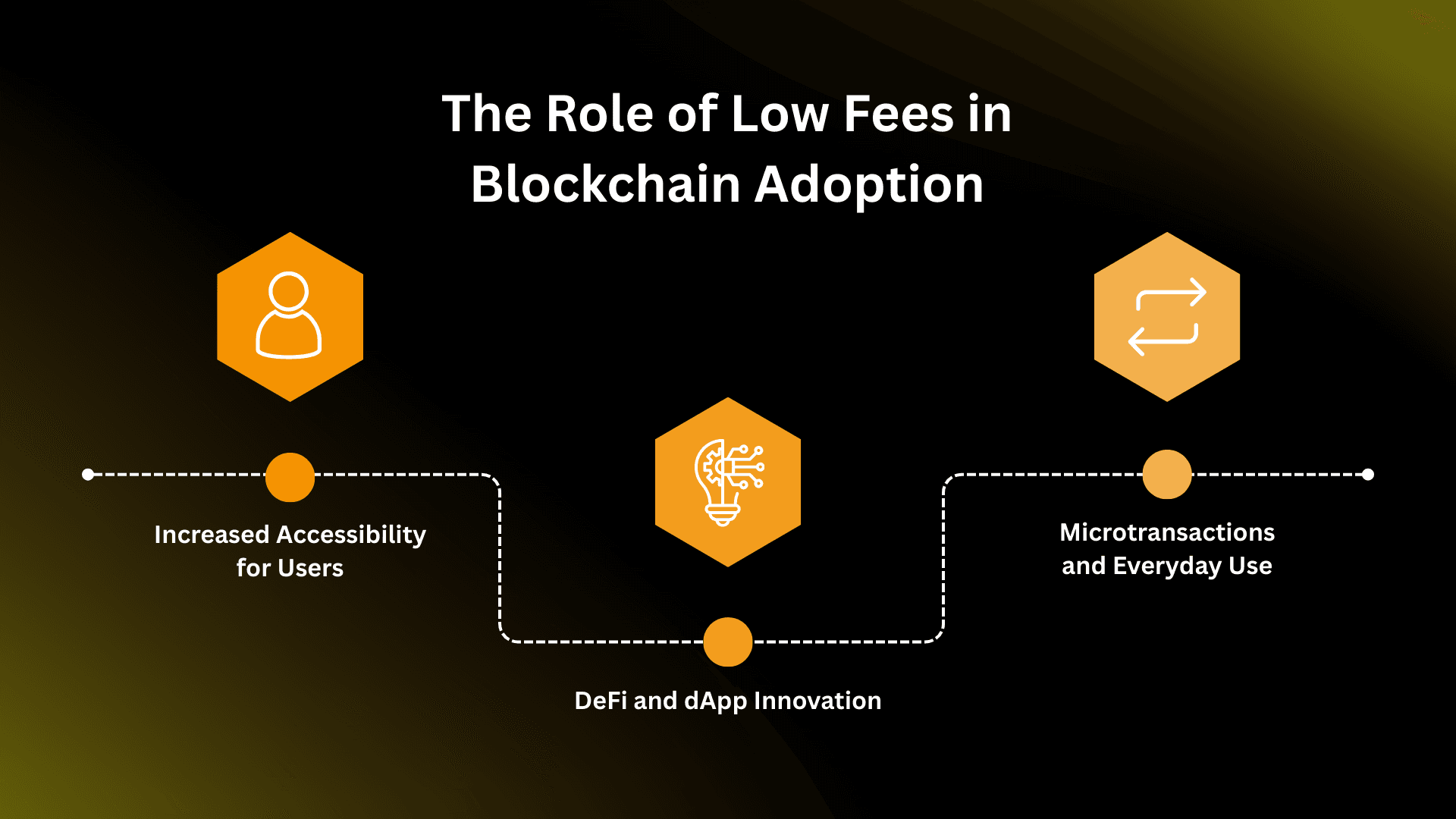
Low Fees Enable Accessibility, Innovation, and Everyday Microtransactions
3.4.1. Increased Accessibility for Users
High fees can be a major barrier for users, particularly for those new to blockchain or in regions with lower purchasing power. BitNetChain’s low transaction fees ensure that blockchain technology is accessible to a broader range of users, including those engaging in DeFi and NFTs.
- Affordable fees make it easy for new users to get started without worrying about high costs.
- Frequent users can benefit from low fees, whether they’re trading tokens or participating in DeFi activities.
3.4.2. DeFi and dApp Innovation
For DeFi applications and decentralized apps (dApps), low fees are essential for sustainability. High fees make it difficult for users to interact with dApps and DeFi platforms, particularly when dealing with small transactions. BitNetChain’s low fees ensure that these applications can operate cost-effectively, attracting more users and encouraging innovation in the space.
- DeFi platforms can offer affordable trading, lending, and borrowing, helping to democratize finance.
- dApps can function more smoothly and attract a larger user base by keeping transaction costs low.
3.4.3. Microtransactions and Everyday Use
Microtransactions are a crucial part of many use cases, from gaming to social media platforms. High transaction fees make it uneconomical for users to send small amounts of digital currency. BitNetChain’s low fees make microtransactions feasible, unlocking new possibilities for in-app purchases, tipping, and small-value exchanges.
- Low fees make gaming and social platforms more accessible by enabling small payments.
- Content creators can benefit from lower transaction costs when receiving tips or micropayments from fans.
3.5. How Low Fees Benefit Developers and Users
For developers, low transaction fees mean they can build scalable dApps without worrying about the cost of running them. It also opens up the possibility for microtransactions, which can be integrated into various applications, including games, content platforms, and e-commerce sites.
For users, low fees provide a seamless experience when interacting with dApps, participating in DeFi, or trading NFTs. BitNetChain ensures that users don’t have to pay excessive transaction costs, making blockchain technology more practical and usable in everyday scenarios.
3.6. Why BitNetChain’s Low Fees Matter for the Future
As blockchain adoption continues to rise, low fees will remain a central factor in ensuring that blockchain technology is usable for the mainstream. BitNetChain is leading the way by offering a blockchain solution that is both affordable and scalable, making it an attractive choice for developers, users, and businesses alike.
By addressing the issue of high transaction fees, BitNetChain is paving the way for widespread blockchain adoption, ensuring that decentralized systems are accessible and functional for everyone.
3.7. FAQ
How does BitNetChain keep transaction fees low?
BitNetChain uses Proof-of-Stake (PoS), dynamic sharding, and optimized transaction execution to keep fees low while maintaining high network performance.
What is the benefit of low fees for DeFi?
Low fees make DeFi applications more accessible by allowing users to trade, lend, and borrow without high transaction costs.
Can BitNetChain handle microtransactions?
Yes, BitNetChain’s low fees make microtransactions feasible, allowing blockchain to be used in gaming, tipping, and other small-value exchanges.
3.8. Conclusion
Low transaction fees are a crucial component of BitNetChain’s success. By offering affordable and scalable solutions, BitNetChain enables a wide range of use cases, from DeFi and NFTs to microtransactions. Its low-fee design ensures that blockchain is accessible to everyone, whether you’re a user, developer, or business. With BitNetChain, low fees are not just a feature—they are the foundation for the future of blockchain technology.
What is BitNetChain Wallet? Seamlessly Manage Assets Across Blockchains
BitNetChain Wallet is a secure, user-friendly wallet that supports BNC and assets from Ethereum, Solana, and other popular blockchains. In this article, we’ll explore how to create, secure, and use your BitNetChain Wallet, along with its unique features and benefits.
4.1. What You'll Learn
- What BitNetChain Wallet is and how it works
- How to create and secure your BitNetChain Wallet
- Multi-chain support across Ethereum, Solana, and more
- Key security features that protect your assets
- How to send, receive, and manage tokens seamlessly
- Unique benefits of using BitNetChain Wallet for Web3 users
4.2. What is BitNetChain Wallet?
BitNetChain Wallet is a versatile tool for users and developers to manage their assets on the BitNetChain network. It supports not only the native coin BNC but also bridged assets from other prominent blockchains, including Ethereum, Solana, and Polygon. This makes it an ideal wallet for those who want to manage and interact with a diverse range of digital assets in a seamless and secure manner.
Whether you're participating in decentralized finance (DeFi), trading tokens, or simply storing assets, BitNetChain Wallet offers an easy way to handle your digital assets securely across multiple blockchains.
4.3. Supported Wallets for BitNetChain
BitNetChain Wallet provides compatibility with various wallets, allowing users to choose their preferred platform to interact with the BitNetChain ecosystem. These wallets range from Ethereum-based solutions to Cosmos-integrated wallets and BitNetChain’s own native wallet. Let’s take a look at the most popular wallet options supported by BitNetChain:
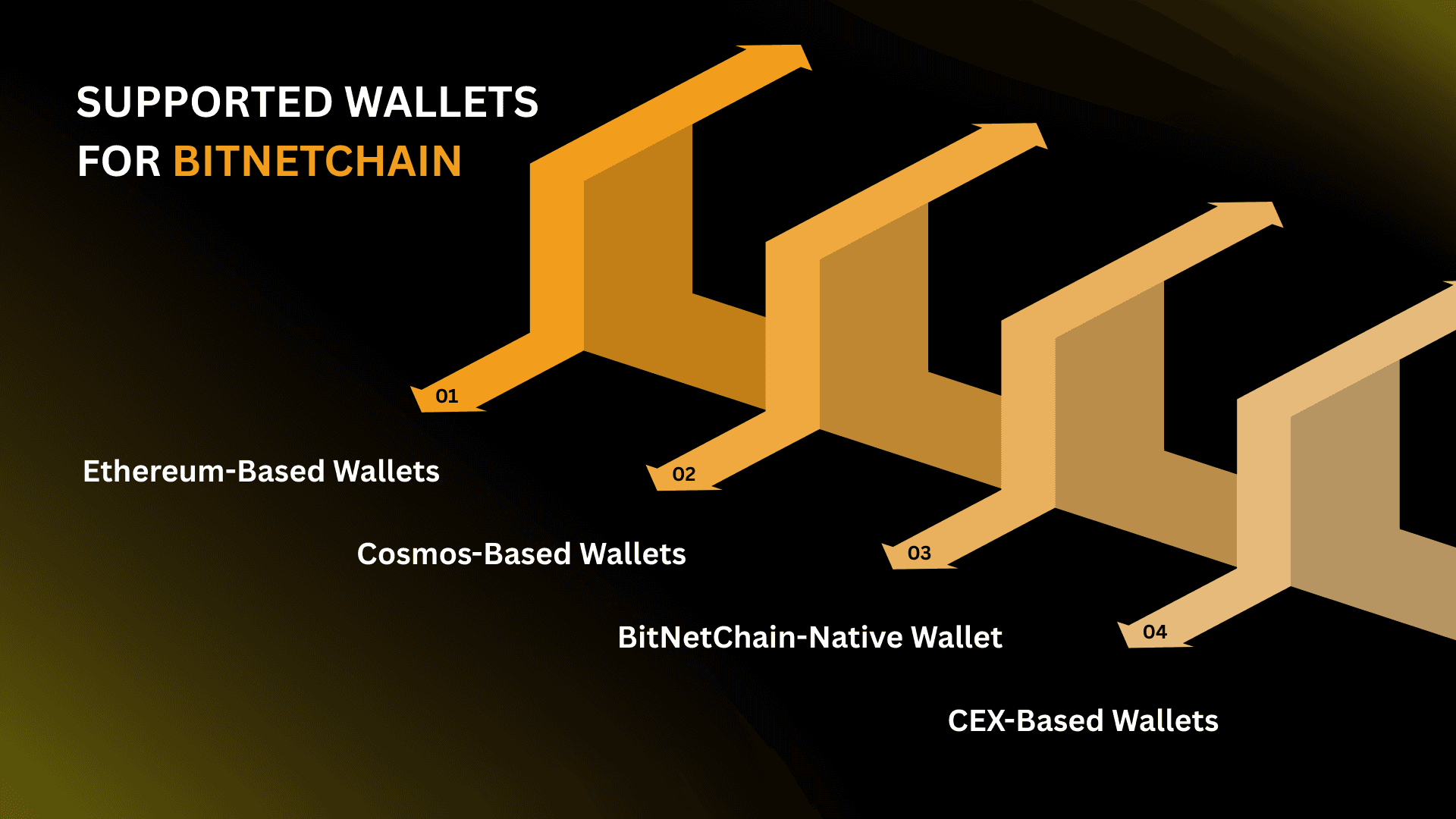
BitNetChain Supported Wallets: Ethereum, Cosmos, Native, and CEX Wallets
4.3.1. Ethereum-Based Wallets
- MetaMask: One of the most widely used Ethereum wallets, MetaMask offers a seamless experience for managing Ethereum-based assets.
- Ledger: A hardware wallet known for its strong security, Ledger can be used to store BitNetChain assets securely.
- Trezor: Another popular hardware wallet option for safely managing crypto assets.
- Torus: A simpler Ethereum wallet option that can be integrated with BitNetChain for user-friendly access.
4.3.2. Cosmos-Based Wallets
- Keplr: A Cosmos wallet widely used for interacting with Cosmos-based chains, including BitNetChain.
- Cosmostation: Another reliable wallet for managing assets within the Cosmos ecosystem.
- Leap: A modern Cosmos wallet that also works with BitNetChain for secure transactions and management.
4.3.3. BitNetChain-Native Wallet
- BitNetChain Wallet: Built specifically for BitNetChain, this native wallet ensures smooth interactions with the BitNetChain ecosystem, providing optimized features tailored for its users.
4.3.4. CEX-Based Wallets
- Bitget Wallet: For centralized exchange (CEX) users, Bitget Wallet supports BitNetChain, making it easy for traders to manage assets on the blockchain.
- OKX Wallet: Another CEX wallet that offers seamless access to BitNetChain, catering to a wide user base in the exchange environment.
4.4. How to Create Your BitNetChain Wallet
Using BitNetChain Wallet is simple and intuitive. Here’s how you can get started:
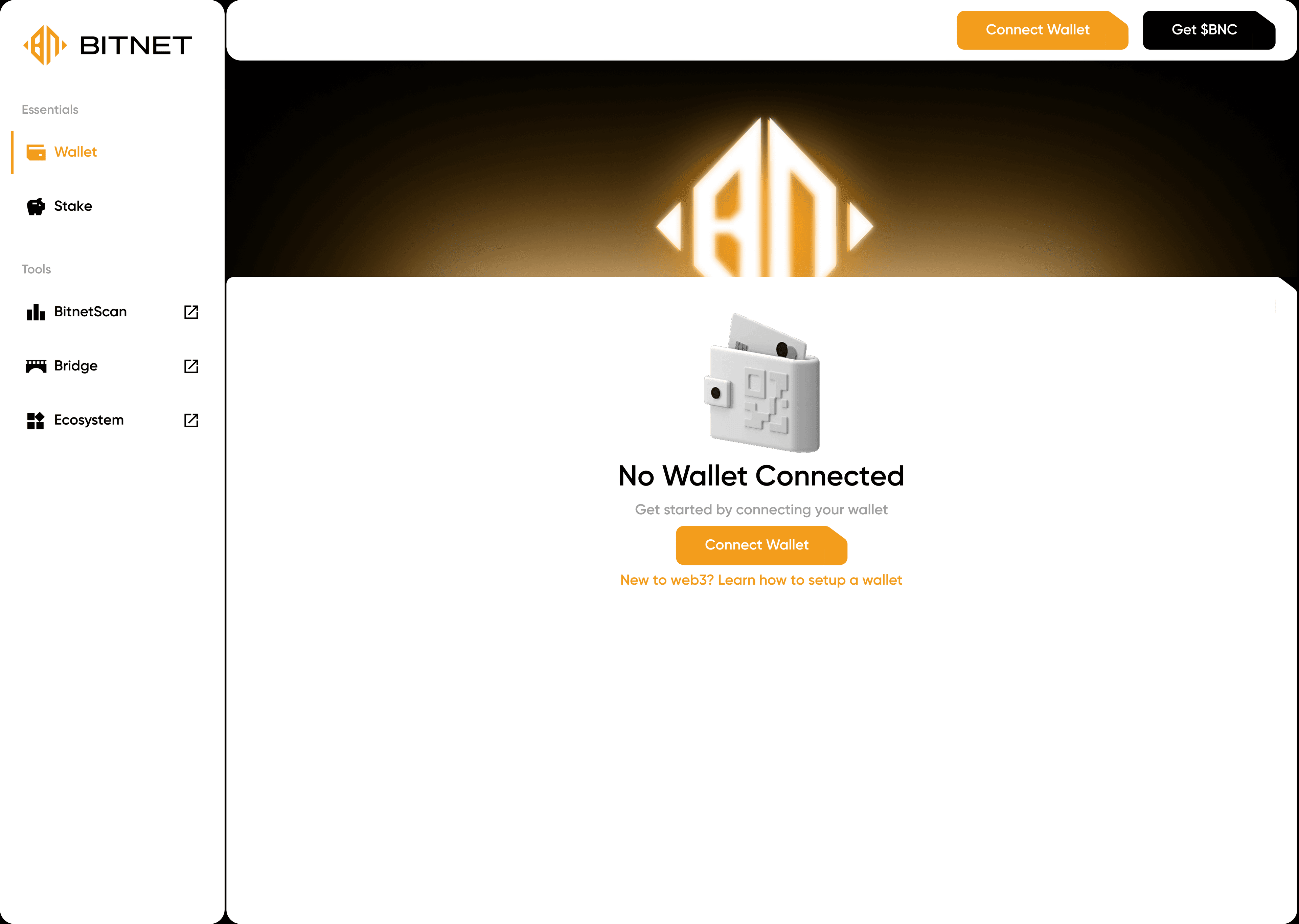
4.4.1. Step 1: Access BitNetChain Wallet
Go to the official BitNetChain Wallet page on your web browser.
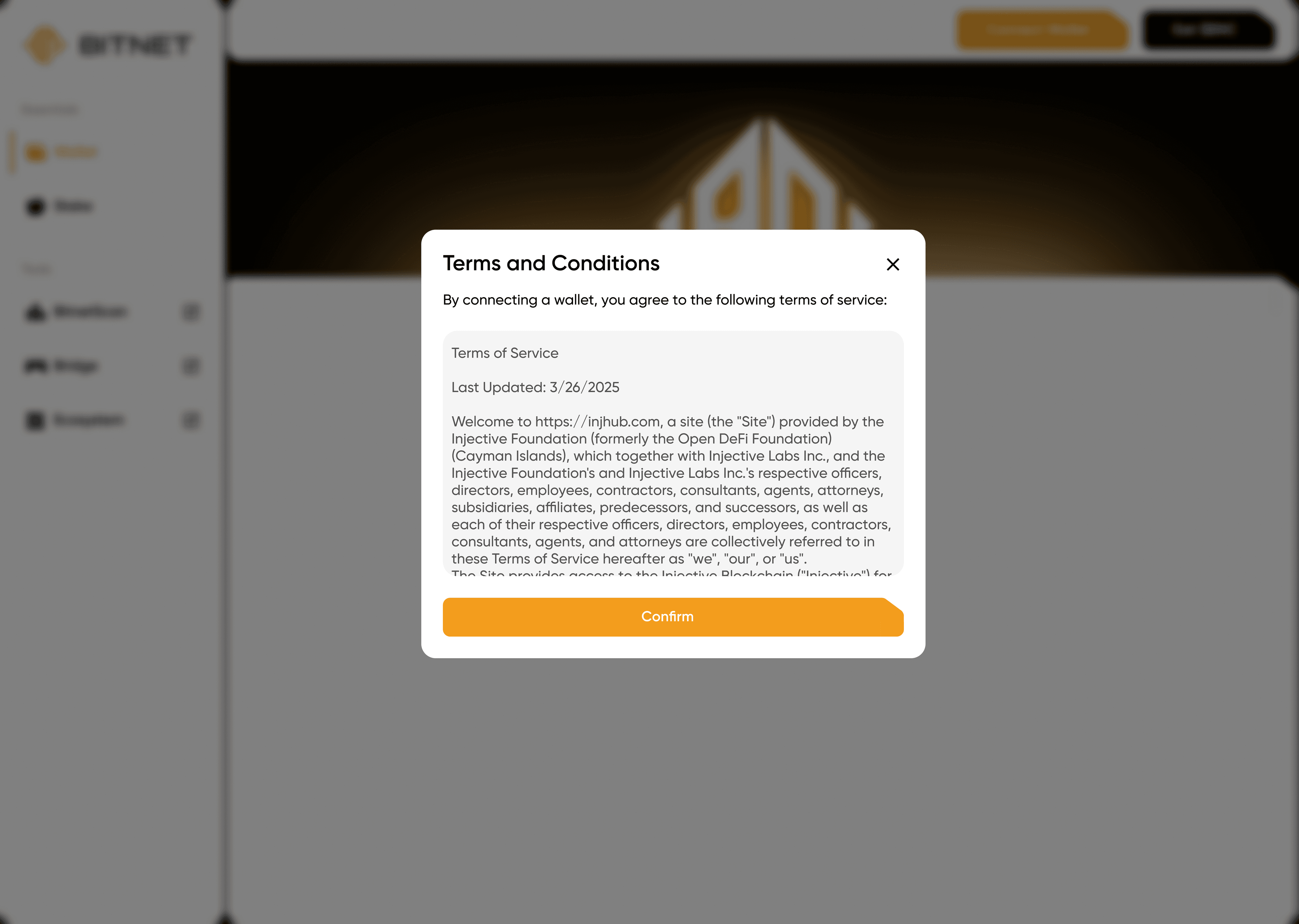
4.4.2. Step 2: Confirm Terms and Conditions
Before connecting your wallet, you will be prompted to review and accept the Terms and Conditions of BitNetChain Wallet.
4.4.3. Step 3: Connect Your Wallet
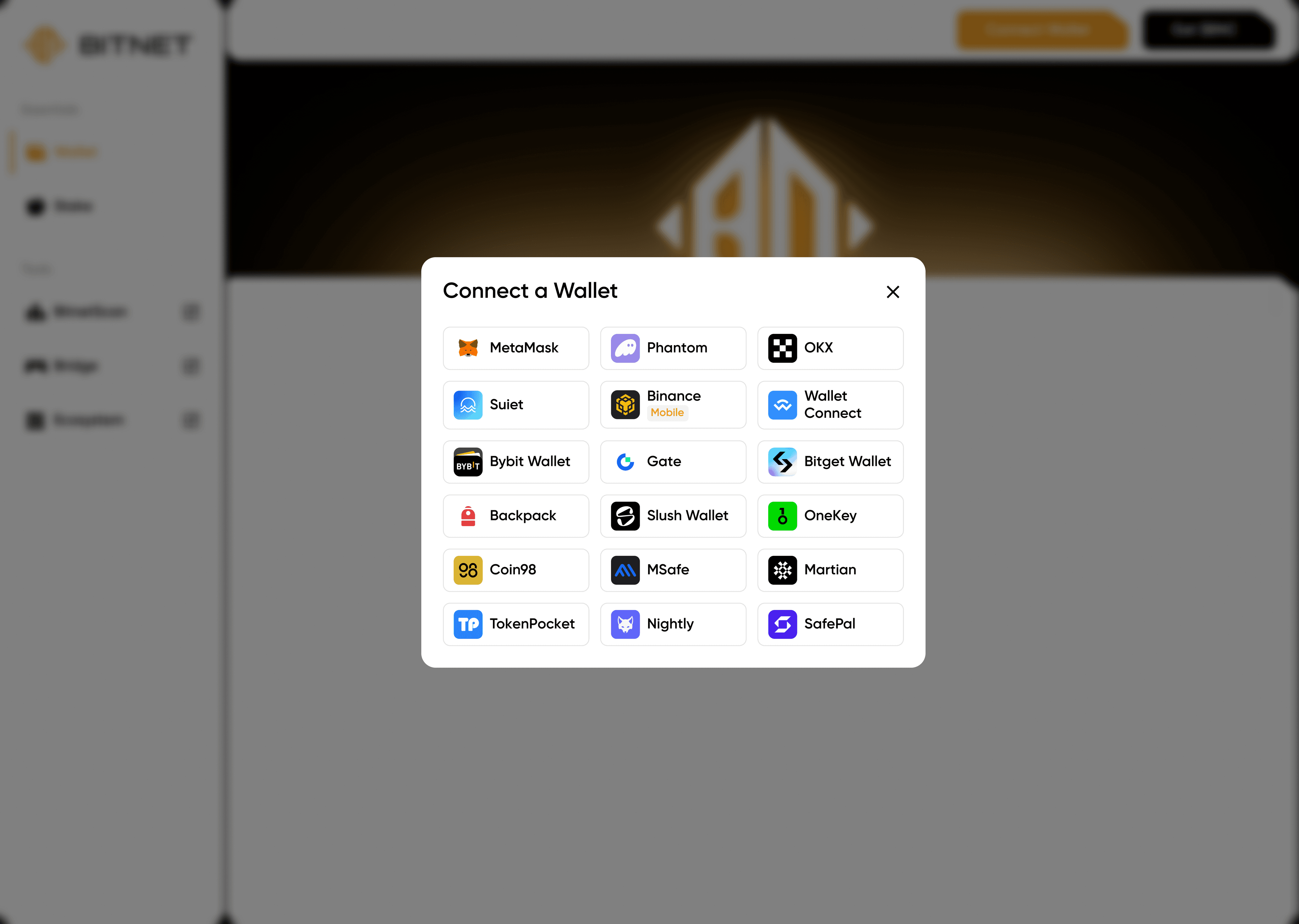
Click on "Connect Wallet" to link your non-custodial wallet. Supported wallets include MetaMask, Phantom, Keplr, Ledger, and more. Once connected, your assets from the BitNetChain network, as well as bridged assets, will be displayed in the wallet.
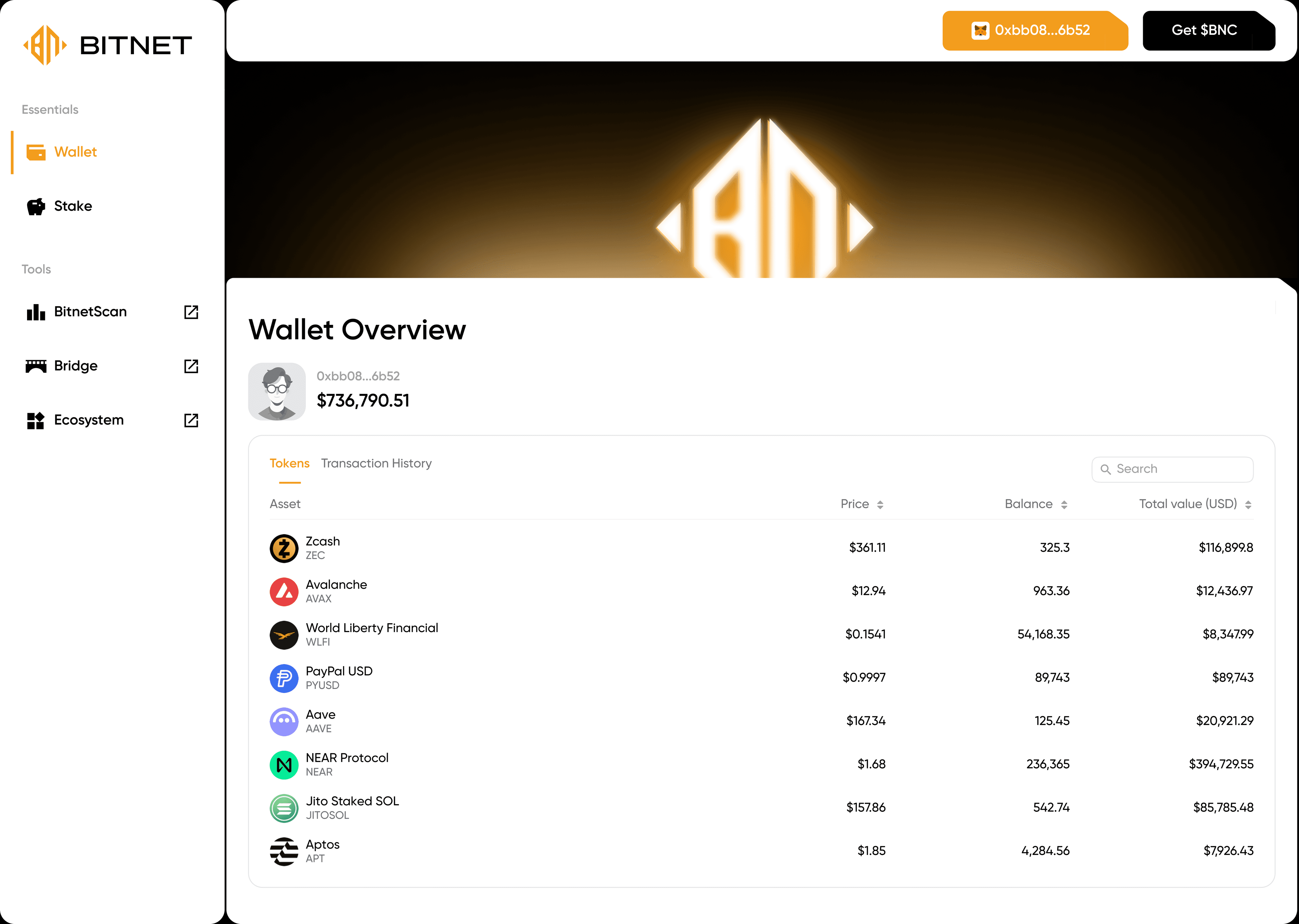
4.4.3. Step 4: Start Managing Your Assets
Once the wallet is connected, you can start managing your assets. BitNetChain Wallet allows you to view your balance and interact with dApps built on BitNetChain, including DeFi platforms, NFTs, and more. You do not need to manually manage private keys for every transaction, as Account Abstraction simplifies this process.
4.5. How to Use BitNetChain Wallet
Once you’ve set up your BitNetChain Wallet, here’s how you can start using it effectively:
4.5.1. Send and Receive Tokens
Whether you’re using BTC, ETH, SOL, or BNC, BitNetChain Wallet allows you to send and receive assets across blockchains seamlessly.
- Send tokens to any address within the BitNetChain ecosystem or from other compatible chains.
- You can also receive assets from other blockchain users or decentralized applications (dApps).
4.5.2. Interact with DeFi and dApps
- Use BitNetChain Wallet to engage with decentralized finance applications (DeFi) built on the BitNetChain ecosystem.
- BitNetChain Wallet also lets you access other dApps, allowing you to trade, provide liquidity, or participate in governance proposals on supported blockchains.
4.5.3. Monitor Transactions and Assets
- Easily track your transaction history, including cross-chain transfers, with the wallet’s simple and intuitive interface.
- Keep an eye on all your digital assets, including those from other supported blockchains like Ethereum, Solana, and more.
4.6. Security and Privacy
Security is a top priority for BitNetChain Wallet, which employs industry-standard encryption methods to protect users’ assets. The wallet supports ECDSA secp256k1 encryption for Ethereum-based assets and ed25519 encryption for consensus nodes, ensuring a high level of security.
- Private Keys: Users have complete control over their private keys, which means your funds are always under your ownership.
- Multi-Factor Authentication (MFA): Enhanced security features such as multi-factor authentication (MFA) help safeguard your wallet from unauthorized access.
4.7. FAQ
What is BitNetChain Wallet?
BitNetChain Wallet is a secure and user-friendly wallet that allows you to manage BNC and assets from other blockchains like Ethereum, Solana, and more.
How do I create a BitNetChain Wallet?
You can create a wallet by connecting an existing Ethereum-based or Cosmos-based wallet (like MetaMask or Keplr) to the BitNetChain network, or by using the native BitNetChain Wallet.
Can I use BitNetChain Wallet with Ethereum-based wallets?
Yes, BitNetChain Wallet is compatible with popular Ethereum wallets such as MetaMask and Ledger, allowing you to manage assets seamlessly across both Ethereum and BitNetChain networks.
Is BitNetChain Wallet secure?
Yes, BitNetChain Wallet uses strong cryptographic standards like ECDSA secp256k1 and ed25519 to secure user assets, ensuring that your funds are protected.
4.8. Conclusion
BitNetChain Wallet is an essential tool for anyone looking to manage their digital assets across multiple blockchains securely. With its seamless integration with Ethereum, Solana, and other popular blockchains, as well as its native wallet features, BitNetChain Wallet provides an easy-to-use, secure, and flexible solution for interacting with decentralized applications and DeFi platforms. Whether you’re a developer, investor, or blockchain enthusiast, BitNetChain Wallet is the key to unlocking your blockchain experience.
What Is Staking on BitNetChain? Benefits, Rewards, and How to Participate
Staking on BitNetChain allows you to earn rewards while helping secure the network. In this article, we cover how staking works, its benefits, and how you can start staking today!
5.1. What You'll Learn
- The basics of staking and how it works on BitNetChain
- Why staking is crucial for securing the network
- Step-by-step guide to getting started with staking on BitNetChain
- How to choose the right validator for staking
- The rewards system and how you can maximize your earnings
- Important considerations when staking, including risks and lock-up periods
- Tips for managing your stake effectively to ensure optimal returns
5.2. What is Staking?
Staking is the process of locking up your cryptocurrency to help maintain the operations of a blockchain network. In return, you earn rewards. BitNetChain, a high-performance Layer 1 blockchain, uses staking to secure its network through its Proof-of-Stake (PoS) consensus mechanism. By staking BitNet Coin (BNC), you contribute to transaction validation and gain rewards for doing so.
On BitNetChain, staking is not just about holding your tokens; it's about actively participating in the security and smooth operation of the network. The more BNC you stake, the greater your chances of earning rewards and participating in network governance.
5.3. How Staking Works
BitNetChain uses the Tendermint-based PoS consensus mechanism, where validators are chosen to propose new blocks and validate transactions. To become a validator, users must stake BNC. As a staker, you can delegate your BNC to a validator, who in turn will use these coins to validate transactions. In return, the validator and delegators share the staking rewards.
The amount of BNC you stake, along with the performance of your chosen validator, directly impacts the rewards you earn. The BitNetChain network ensures that this process remains secure, decentralized, and efficient, processing over 50,000 transactions per second (TPS) with sub-600 millisecond finality.
5.4. Why Networks Need Staking
Staking plays a vital role in securing blockchain networks, especially those based on PoS. Unlike Proof-of-Work (PoW) blockchains, which rely on energy-intensive mining, PoS networks like BitNetChain use staking to validate transactions and maintain network consensus.
Staking ensures:
- Security: The network remains resistant to attacks because validators are incentivized to act honestly. If a validator misbehaves, they lose part of their staked coins (a process called "slashing").
- Decentralization: Staking allows more participants to engage in network operations, ensuring that no single entity can control the blockchain.
- Efficiency: PoS, through staking, provides faster finality and lower transaction costs compared to PoW networks.
By participating in staking, you contribute to the overall health of the network, helping it grow and scale in a sustainable manner.
5.5. Getting Started with Staking on BitNetChain
Staking on BitNetChain is simple and rewarding. Here's how you can get started:
5.5.1. Connect Your Wallet
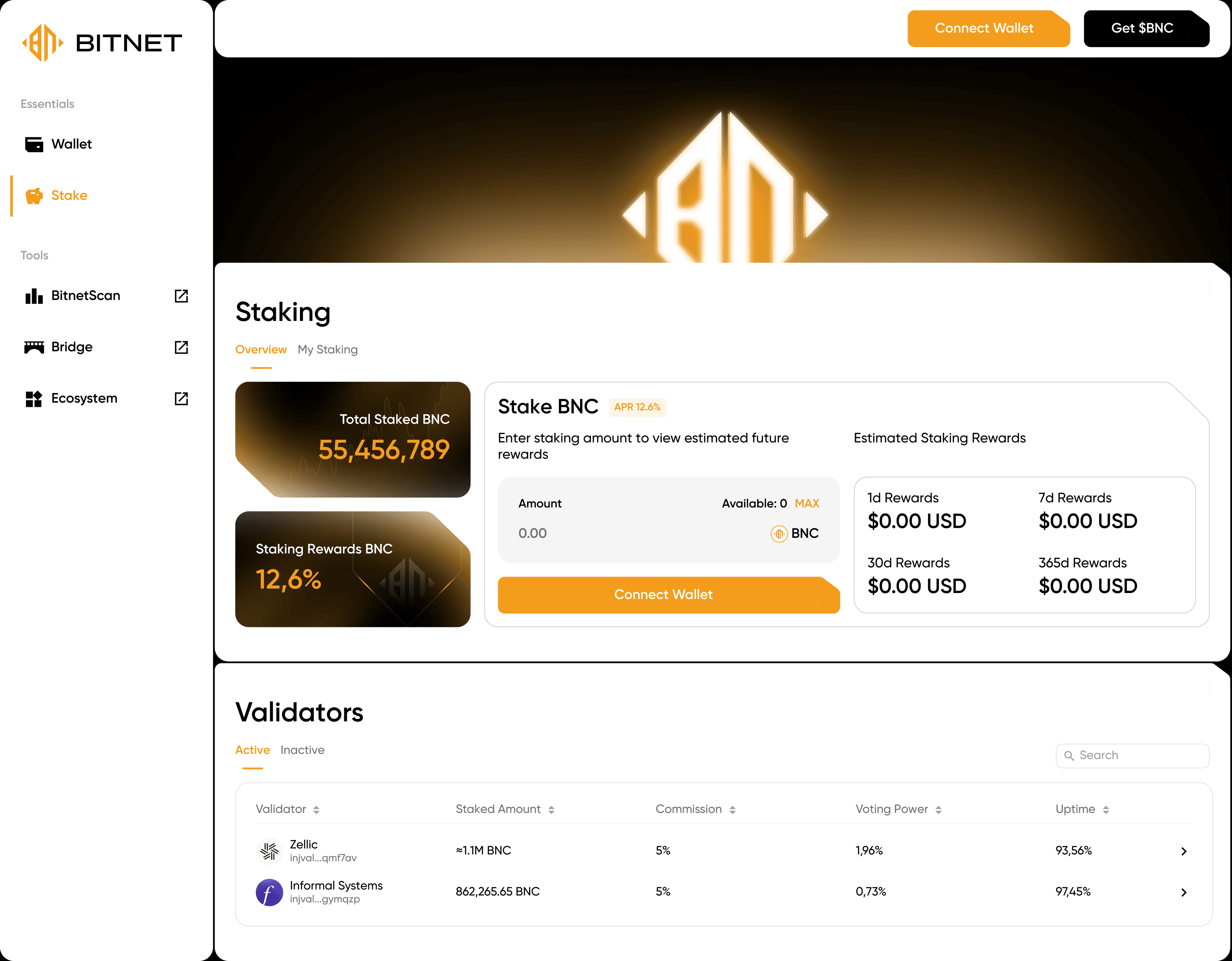
Visit the BitNetChain staking page and connect your wallet. Make sure you have BNC in your wallet, either purchased from a supported exchange or transferred from another wallet.
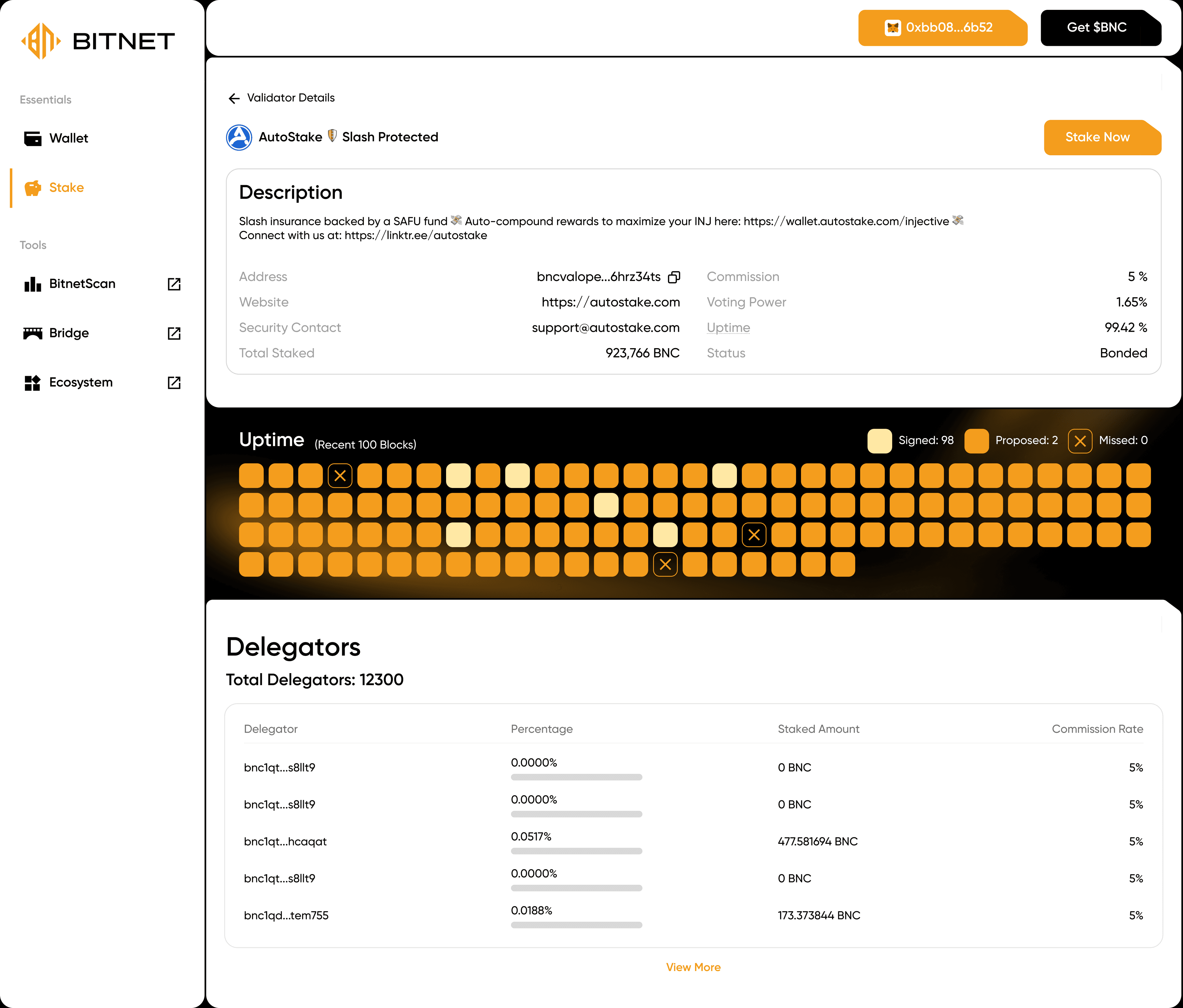
5.5.2. Choose a Validator
Validators are responsible for processing transactions. When staking, you delegate your BNC to a validator. It's important to select a reliable validator that has a good track record and is active in the network.
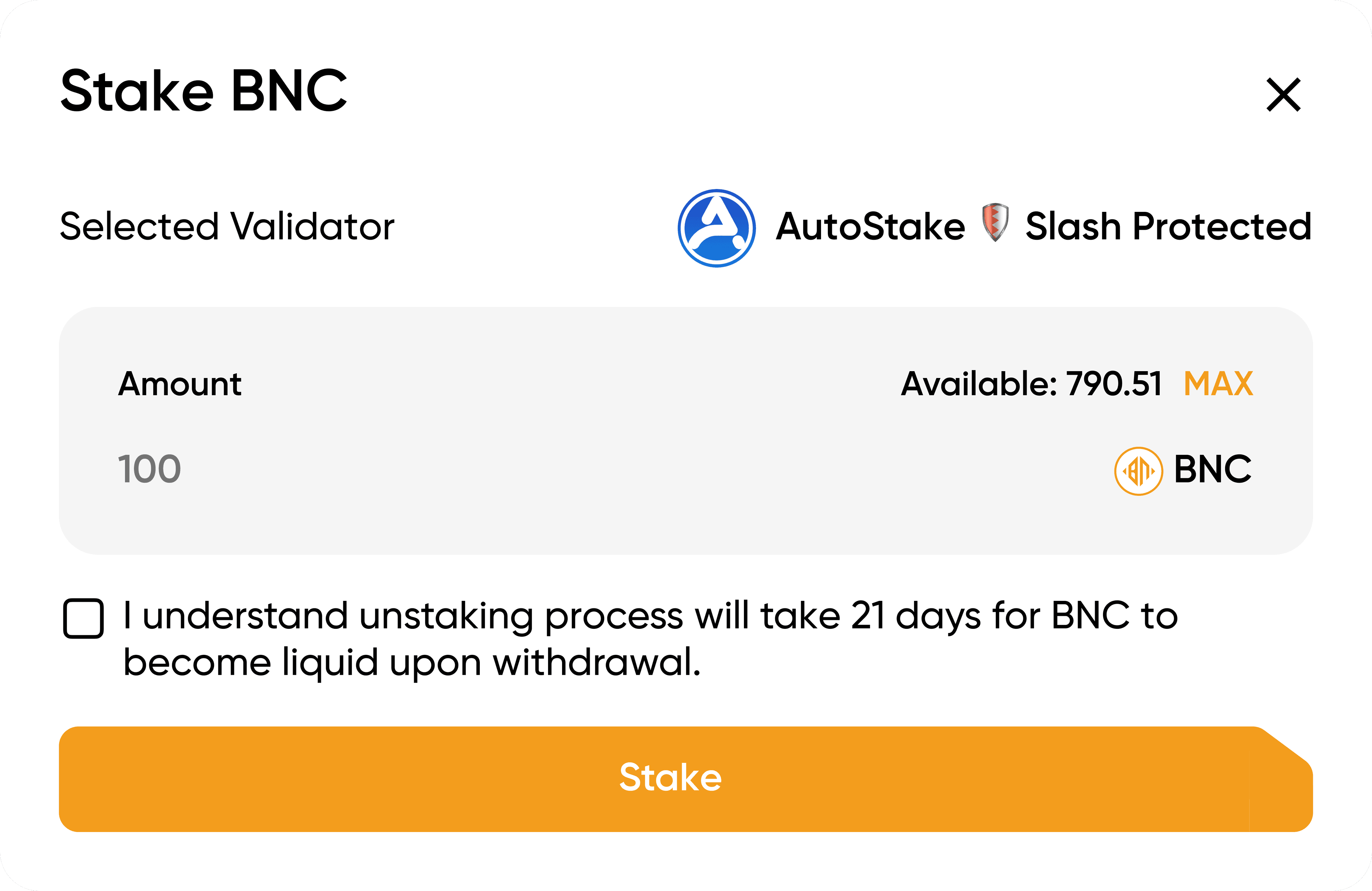
5.5.3. Delegate Your BNC
Once you've selected a validator, you can delegate your BNC to them.
5.5.4. Monitor Your Stake
After delegating your BNC, keep track of your rewards and validator performance. You can adjust your stake or switch validators if necessary.
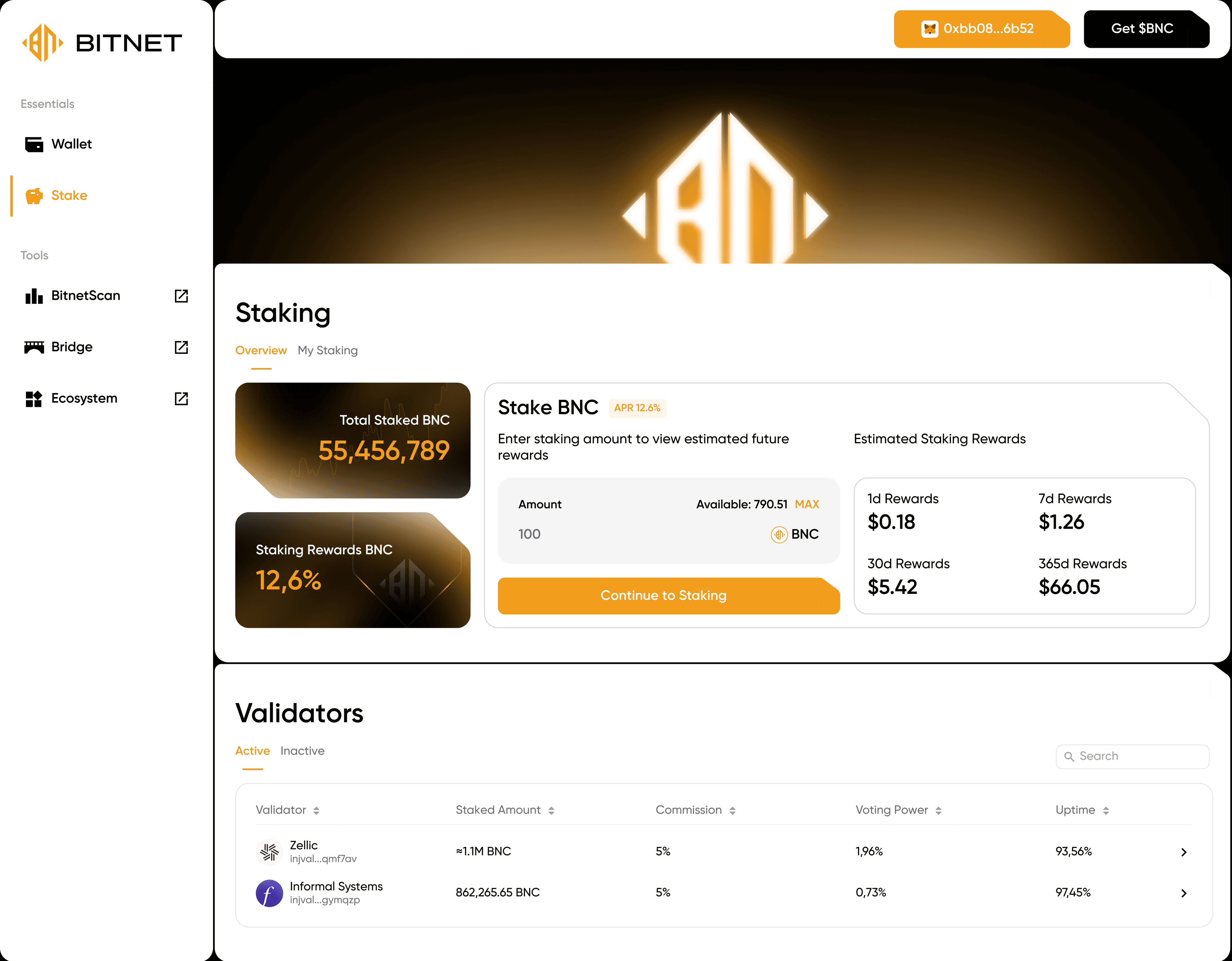
5.6. Staking Rewards
Staking rewards on BitNetChain are generated from transaction fees and block rewards. As a staker, you earn a share of these rewards proportional to your stake.
Key points about staking rewards:
- Rewards Frequency: Staking rewards are distributed regularly, and you can choose whether to compound them (re-delegate) or withdraw them.
- Validator Performance: Your rewards depend not only on the number of BNC you stake but also on how well your validator performs. Choose a validator with low downtime and consistent block validation.
- Economic Incentives: The BNC’s fixed supply and deflationary model, which includes burning 20% of transaction fees, adds value to staking rewards by increasing the scarcity of the coin over time.
The higher the stake, the more potential rewards you can earn. However, it's important to consider validator reliability and network conditions when estimating your returns.
5.7. Managing Your Stake
Properly managing your stake is crucial for maximizing rewards and minimizing risks. Here are a few tips to ensure you're optimizing your staking experience:
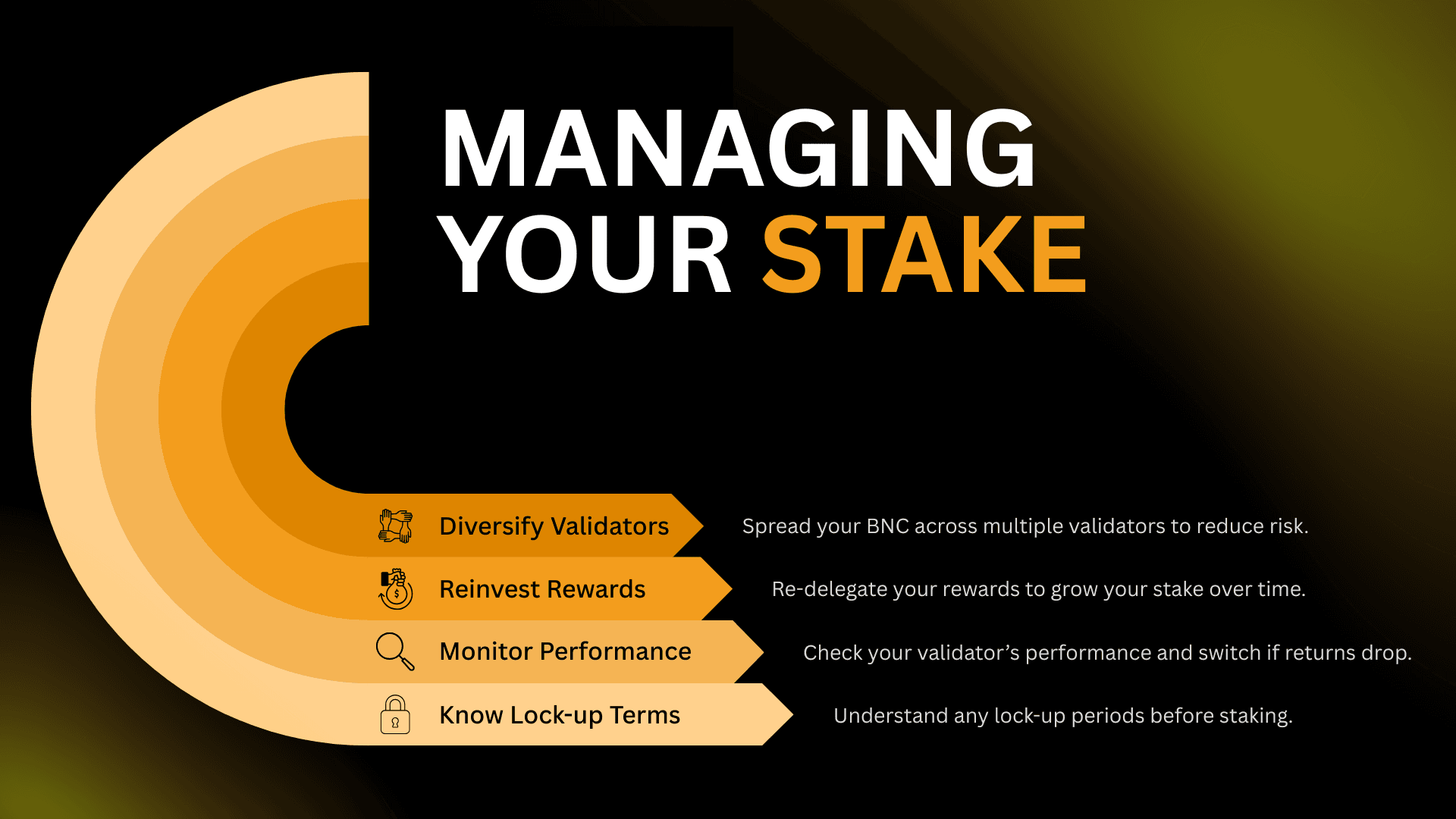
Managing Your Stake: Diversify Validators, Reinvest Rewards, Monitor Validator Performance, and Understand Lock-Up Periods
- Diversify Your Validators: To spread risk, consider delegating your BNC to multiple validators. This reduces the impact if one validator underperforms or is penalized.
- Reinvest Your Rewards: Compounding your rewards by re-delegating them helps grow your stake over time, leading to more rewards.
- Monitor Validator Performance: Regularly check on your validator’s performance. If they are not performing well, or their rewards are too low, consider switching to another validator to ensure consistent returns.
- Understand Lock-up Periods: Some staking programs may have lock-up periods, meaning you can't withdraw your BNC for a certain time. Make sure you understand these terms before committing.
5.8. Important Considerations
Before staking your BNC on BitNetChain, it’s important to be aware of several key factors:
- Validator Risk: Validators can be penalized for bad behavior, and stakers may lose part of their staked coins as a result (slashing). Always choose reputable validators.
- Network Conditions: Staking rewards fluctuate based on network activity. Keep an eye on the overall staking participation and rewards distribution.
- Lock-up Periods: Some staking options might involve a lock-up period during which your BNC cannot be accessed or transferred. Ensure you're comfortable with this before staking.
- Fees: Delegating your BNC to a validator might incur transaction fees, though these are typically small. Ensure you're aware of these fees and factor them into your staking decisions.
5.9. FAQ
How much can I earn from staking on BitNetChain?
The staking rewards depend on the amount of BNC you stake and the validator’s performance. On average, you can expect to earn a percentage of your staked amount annually, with fluctuations based on network conditions.
How do I choose a validator?
Choose a validator with a strong track record, low downtime, and fair commission rates. You can check a validator’s performance through the BitNetChain staking dashboard.
Is there any risk involved in staking?
Yes, if a validator misbehaves, they can be slashed, and you may lose some of your staked tokens. Always choose trusted validators and monitor their performance regularly.
5.10. Conclusion
Staking on BitNetChain offers an opportunity to earn rewards while contributing to the network’s security and decentralization. By understanding how staking works, choosing a reliable validator, and actively managing your stake, you can maximize your rewards and play an essential role in BitNetChain's success. Start staking today to secure the network, earn passive income, and be part of the future of decentralized finance.
Unlock DeFi on BitNetChain and Discover Opportunities in Decentralized Finance
DeFi on BitNetChain revolutionizes decentralized finance with low-cost, high-speed transactions and seamless interoperability. Learn how to engage with DeFi protocols on this advanced blockchain.
6.1. What You'll Learn
- Key concepts and principles of decentralized finance (DeFi)
- How DeFi operates on BitNetChain and why it's optimized for financial applications
- Types of DeFi applications supported on BitNetChain
- How to evaluate DeFi opportunities in this ecosystem
- Steps to get started with DeFi on BitNetChain
- Common questions and essential considerations in DeFi on BitNetChain
6.2. What is DeFi on BitNetChain?
Decentralized Finance (DeFi) has taken the financial world by storm, allowing users to engage in financial activities like lending, borrowing, and trading without intermediaries. BitNetChain, with its DeFi-first philosophy, offers a blockchain platform designed to support high-performance, low-cost, and secure DeFi applications.
BitNetChain’s low transaction fees and rapid transaction finality make it an ideal environment for DeFi, where every second and cent counts. From decentralized exchanges (DEXs) to liquidity pools and beyond, BitNetChain is revolutionizing the DeFi landscape.
6.3. Understanding DeFi
DeFi refers to a suite of financial services that operate on decentralized blockchain networks. Unlike traditional finance, which relies on centralized institutions, DeFi platforms are built using smart contracts and decentralized applications (dApps). These protocols allow users to engage in activities such as lending, borrowing, yield farming, and trading without the need for middlemen.
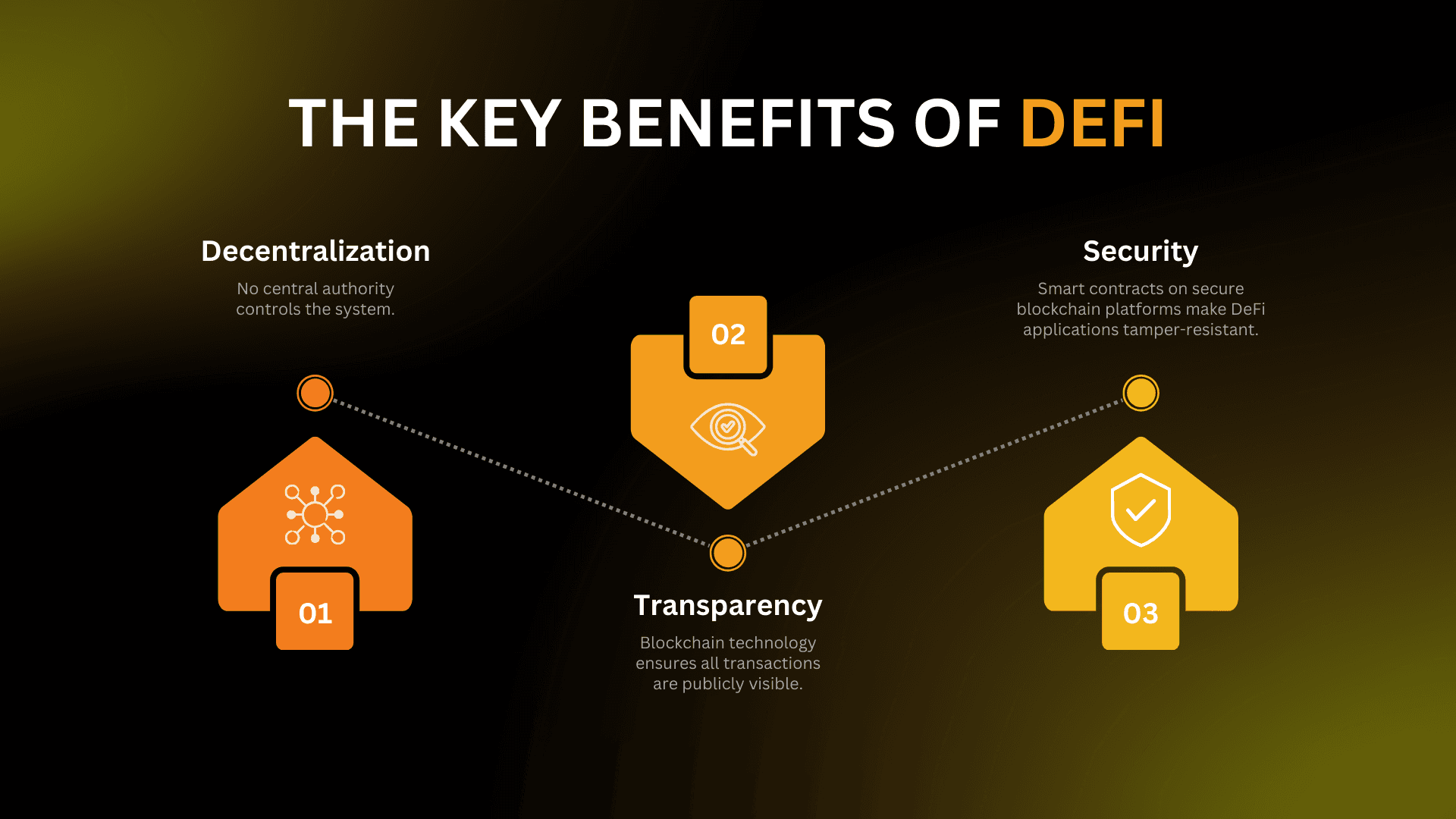
The key benefits of DeFi: Decentralization, Transparency, and Security
BitNetChain leverages these principles to offer an ecosystem that supports the scalability and low transaction fees necessary for DeFi to thrive.
6.4. Key Concepts to Understand
To fully grasp how DeFi operates on BitNetChain, it's essential to understand a few core concepts:
- Smart Contracts: Self-executing contracts with the terms of the agreement directly written into code. These form the backbone of most DeFi protocols.
- Liquidity Pools: Pools of tokens locked in smart contracts that allow users to trade or earn rewards by providing liquidity.
- Decentralized Exchanges (DEXs): Platforms where users can trade assets directly without intermediaries.
- Automated Market Makers (AMMs): Algorithms that automatically set prices based on supply and demand in liquidity pools.
On BitNetChain, these components are integrated into the platform natively, ensuring smooth and low-cost operation of DeFi applications.
6.5. Types of DeFi Applications
BitNetChain’s infrastructure is built to deliver low transaction fees and fast confirmation times, two factors that matter most for real-time trading and high-frequency DeFi activities. By taking a DeFi-first approach, BitNetChain creates a reliable foundation for the most common types of decentralized finance applications, including:
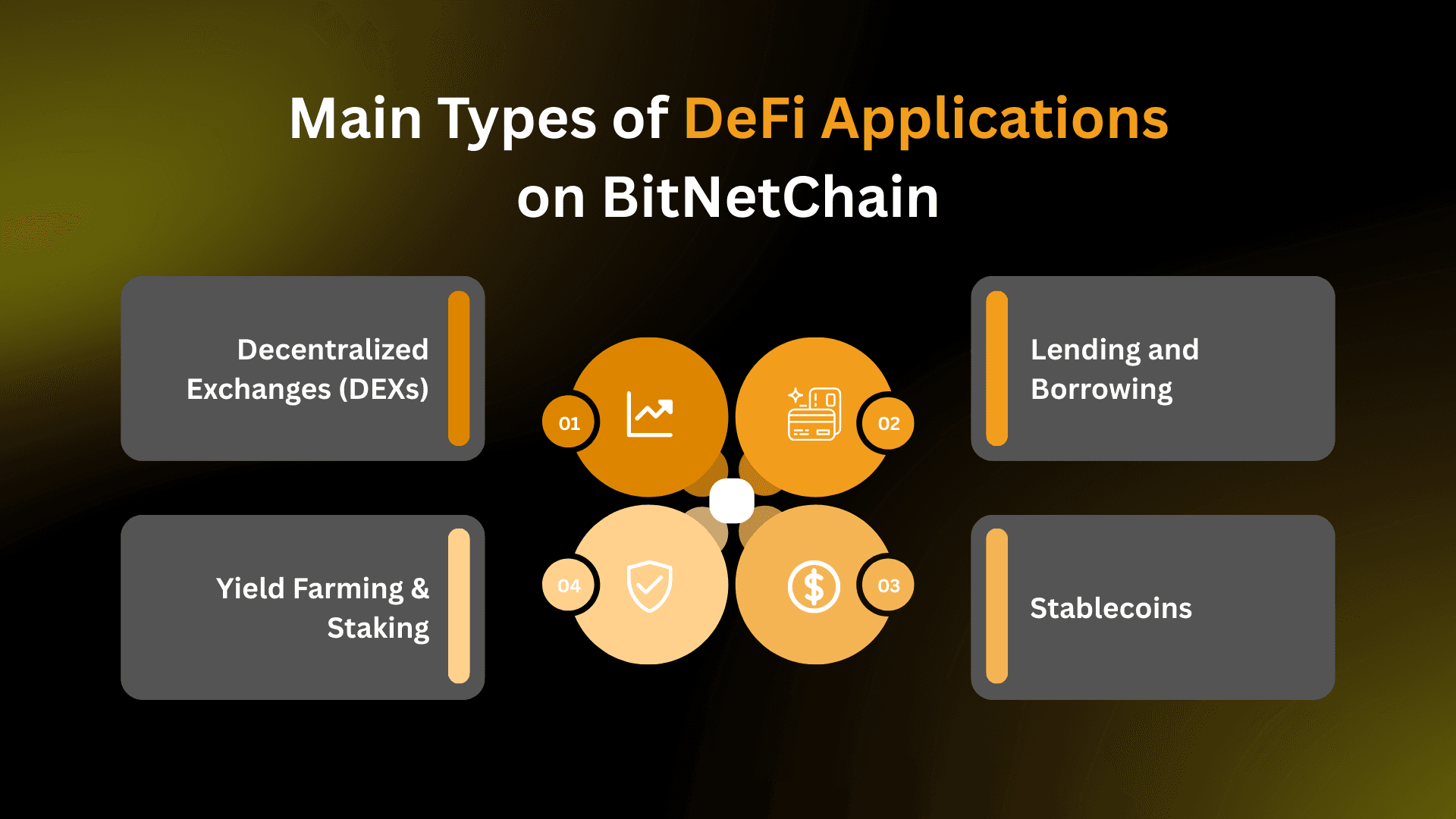
Main Types of DeFi Applications on BitNetChain
- Decentralized Exchanges (DEXs): BitNetChain supports fast, low-fee decentralized exchanges where users can trade tokens directly without relying on centralized platforms.
- Lending and Borrowing Platforms: DeFi platforms for lending and borrowing assets, where users can earn interest on their deposits or borrow assets by providing collateral.
- Stablecoins: BitNetChain enables the creation of stablecoins, which are pegged to assets like the US Dollar, allowing users to mitigate volatility risks common in cryptocurrency markets.
- Yield Farming & Staking: Users can lock their tokens in liquidity pools to earn rewards, encouraging the distribution and growth of tokens in the ecosystem.
6.6. Evaluating DeFi Opportunities
When evaluating DeFi opportunities on BitNetChain, consider the following factors:
- Transaction Fees: BitNetChain’s ultra-low transaction fees ensure that even small-value transactions can be processed without high costs, a key factor for DeFi adoption.
- Security: DeFi applications rely heavily on smart contracts, and the security of these contracts is paramount. BitNetChain’s PoS (Proof of Stake) mechanism combined with Byzantine Fault Tolerance (BFT) ensures the network’s integrity.
- Interoperability: BitNetChain supports interoperability with over 23 directly connected blockchains and 110+ additional chains via the Universal Bridge, which allows DeFi protocols to tap into liquidity across different ecosystems.
- Liquidity: The more liquidity a platform has, the more successful it is likely to be. BitNetChain’s built-in liquidity pools and DEXs make it easier for applications to access and manage liquidity.
6.7. Getting Started with DeFi on BitNetChain
Getting involved in DeFi on BitNetChain is straightforward. Here’s how you can start:
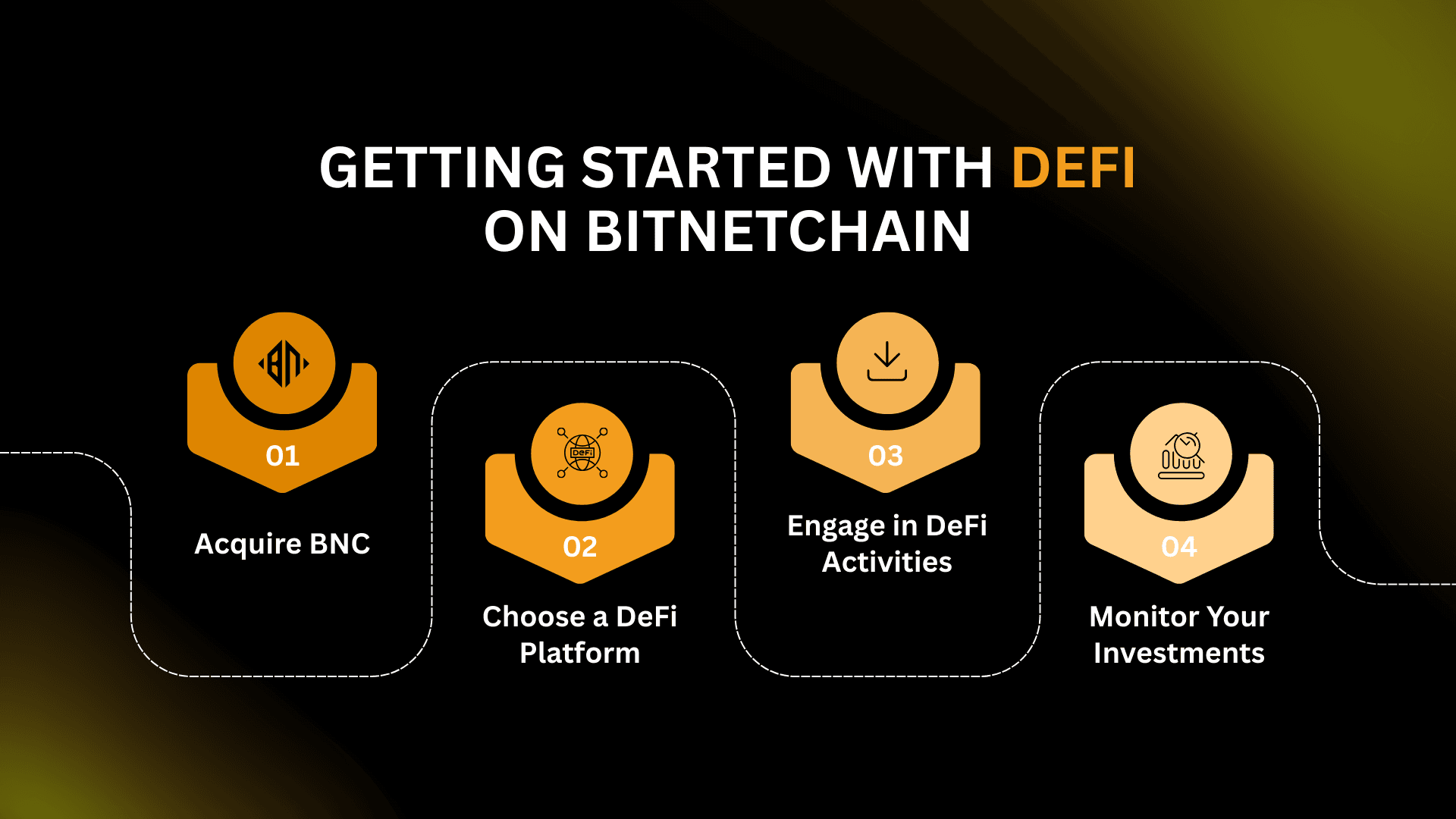
Getting Started with DeFi on BitNetChain
- Acquire BitNet Coin (BNC): You need BitNet Coin (BNC) to participate in DeFi activities such as staking, lending, or trading. BNC can be obtained through exchanges or other users within the BitNetChain ecosystem.
- Choose a DeFi Platform: Based on your interest (lending, staking, trading), you can select a DeFi platform built on BitNetChain. Make sure to choose platforms that align with your goals and risk tolerance.
- Engage in DeFi Activities: Whether it's providing liquidity, lending, or earning rewards from staking, start participating in the ecosystem to earn returns on your BNC.
- Monitor Your Investments: As with any financial activity, regularly check the performance of your DeFi investments. BitNetChain’s low transaction fees ensure that you can easily manage your assets without incurring high costs.
6.8. FAQ
What are the fees for DeFi transactions on BitNetChain?
BitNetChain offers ultra-low transaction fees, typically under $0.00001, making it one of the most cost-effective platforms for DeFi activities.
How does BitNetChain ensure security in DeFi applications?
BitNetChain uses a combination of PoS and Byzantine Fault Tolerance (BFT) for transaction validation. Additionally, the platform integrates zk-SNARKs and zk-STARKs for enhanced privacy and security in DeFi applications.
Can I access liquidity from other blockchains in DeFi?
Yes, BitNetChain’s cross-chain interoperability via the Universal Bridge and IBC ensures seamless liquidity access across multiple blockchain ecosystems, allowing DeFi applications to thrive.
6.9. Conclusion
DeFi on BitNetChain presents an exciting opportunity for users and developers to engage in decentralized finance with low transaction costs, high performance, and robust security. With native support for DEXs, liquidity pools, and lending platforms, BitNetChain is paving the way for a new era of decentralized financial applications. Whether you’re a user looking to earn rewards or a developer seeking to build the next big DeFi protocol, BitNetChain’s infrastructure offers the perfect environment for your success. Start exploring DeFi on BitNetChain today and become a part of the decentralized future.
Tokenizing Real-World Assets on BitNetChain for Global Markets
BitNetChain brings real-world assets on-chain with secure, scalable infrastructure. Discover how its high-performance architecture enables global RWA markets and institutional-grade tokenization.
7.1. What You'll Learn
- Core concepts of Real-World Asset (RWA) tokenization
- How BitNetChain’s infrastructure supports secure and scalable RWA platforms
- Key features including IBC interoperability, low fees, privacy, and enterprise identity
- RWA use cases across finance, supply chain, real estate, and sustainability
- Common questions about tokenization and compliance on BitNetChain
7.2. What Is RWA?
Real-World Assets (RWA) are physical or traditional financial assets represented as digital tokens on a blockchain. These assets include real estate, treasury bills, commodities, carbon credits, private equity, luxury goods, intellectual property, and supply chain assets such as invoices or warehouse receipts.
Tokenizing RWA converts ownership rights into digital tokens that can be traded, fractionalized, collateralized, or integrated into decentralized financial applications. By replacing manual paperwork and fragmented records, RWA tokenization enables transparent asset management, instant settlement, and global access to markets traditionally reserved for institutional investors.
As blockchain infrastructure matures, RWA is becoming one of the fastest-growing segments in Web3 because it bridges traditional capital markets with programmable digital economies.
7.3. Why BitNetChain Is Built for the Future of RWA
BitNetChain is designed as a high-performance Layer 1 capable of supporting institutional-grade asset tokenization. The network combines secure consensus, multi-environment smart contracts, interoperability, and privacy tools to serve both consumer and enterprise markets.
Below are the core pillars that make BitNetChain ideal for RWA tokenization:
High Performance for Institutional Workloads
RWA platforms require fast clearing and settlement to manage large volumes of transactions, corporate actions, compliance checks, and collateral adjustments. BitNetChain is engineered to deliver more than 50,000 transactions per second with finality under 600ms, ensuring real-time asset movement suitable for marketplaces, exchanges, and custody providers.
This performance eliminates bottlenecks commonly found in legacy blockchains and allows RWA issuers to scale without compromising user experience or operational efficiency.
Ultra-Low Fees for Scalable Tokenization
RWA ecosystems often involve continuous microtransactions:
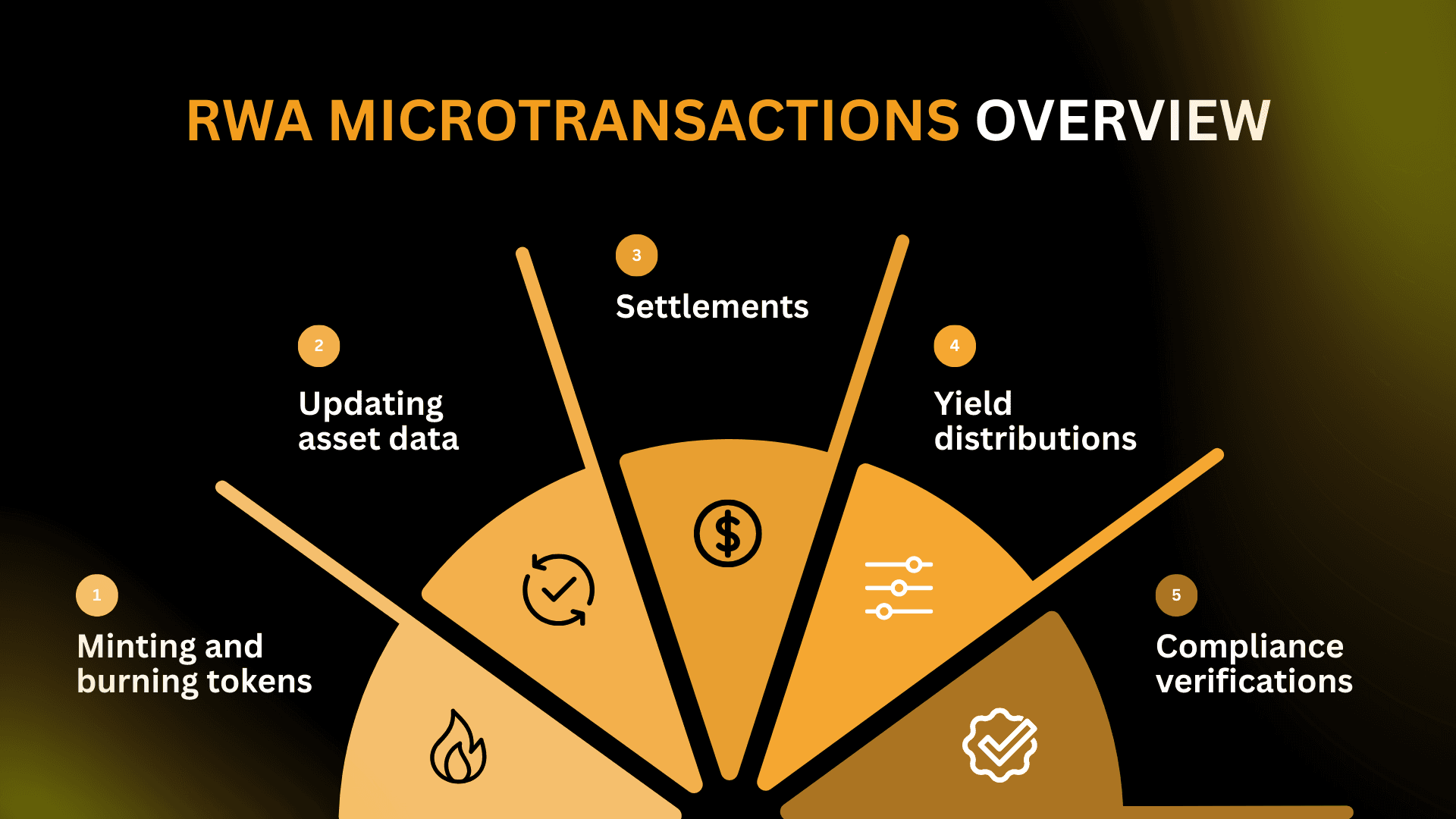
RWA Microtransactions Overview
With transaction fees averaging ~$0.00001, BitNetChain supports cost-efficient execution even for high-frequency asset flows. This makes tokenization and ongoing asset management economically viable for enterprises and retail markets alike.
7.4. Security and Compliance as First-Class Principles
Tendermint PoS + BFT Consensus
BitNetChain relies on Tendermint Proof-of-Stake with Byzantine Fault Tolerance, delivering deterministic finality and reducing the risks of chain reorganizations or rollbacks. Such guarantees are essential for regulated assets where every transaction must be final and auditable.
The validator set strengthens decentralization and provides a secure environment for issuing and transferring tokenized assets.
Multi-VM Support for Flexible Deployment
RWA platforms vary widely in design, compliance requirements, and integration needs. BitNetChain supports both:
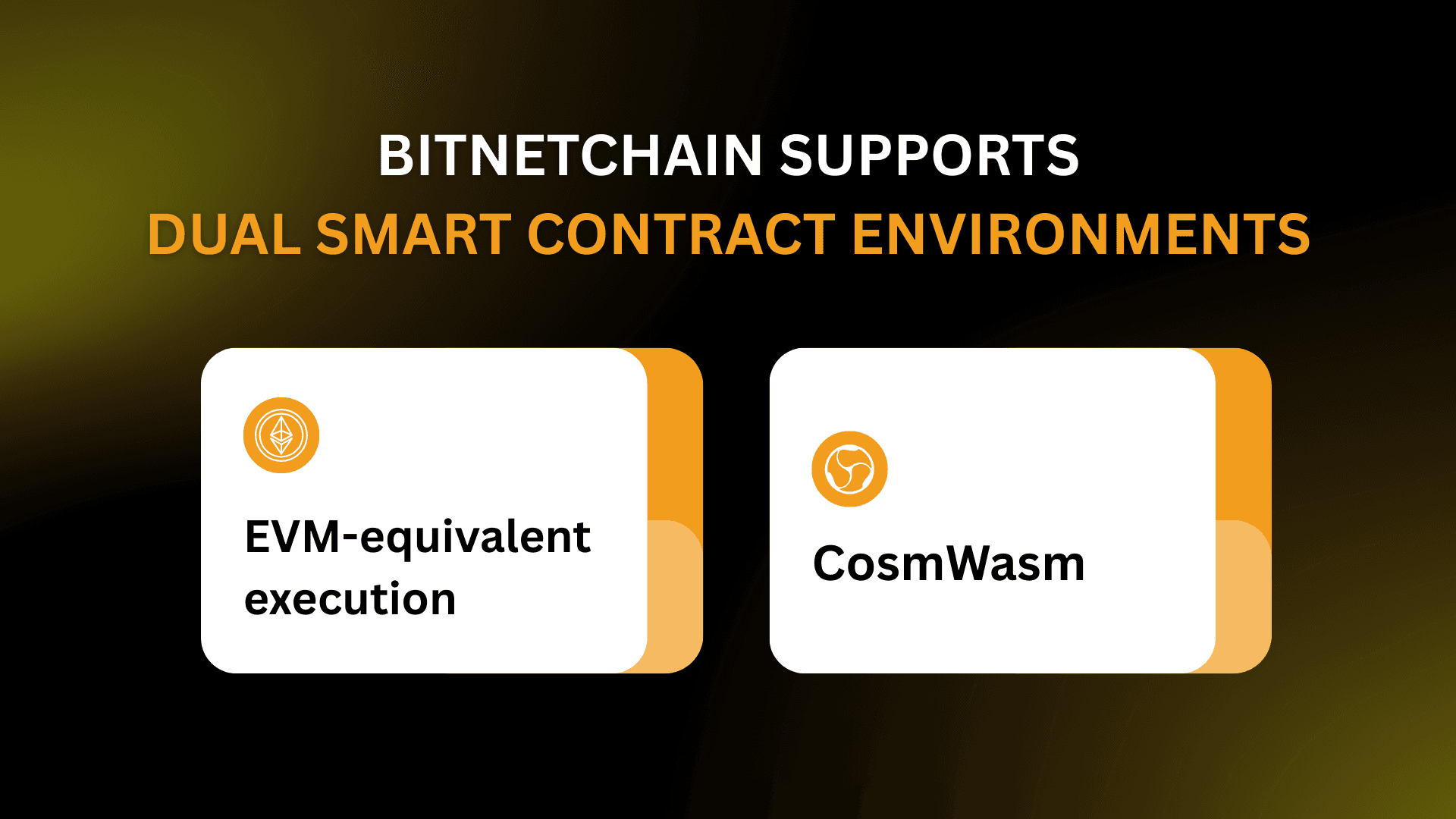
BitNetChain supports Dual Smart Contract Environments
- EVM-equivalent execution: enabling Solidity-based smart contracts
- CosmWasm: enabling secure, lightweight, and modular smart contracts for asset logic
This dual-VM architecture allows organizations to build RWA products using familiar tooling and languages while benefiting from BitNetChain’s optimized runtime.
7.5. Seamless Interoperability for Global Asset Movement
7.5.1. Native IBC Integration
Inter-Blockchain Communication (IBC) allows BitNetChain to connect trustlessly with more than 20 Cosmos-based networks. For RWA platforms, this provides direct pathways to cross-chain liquidity, multi-chain issuance models, and institutional-grade custody systems.
7.5.2. Universal Bridge
Beyond IBC, BitNetChain offers a universal bridging layer that connects more than 110 blockchain networks. This enables RWA tokens to flow into ecosystems like Ethereum, Solana, BNB Chain, and other liquidity hubs.
Interoperability ensures that tokenized assets can reach global buyers, lenders, exchanges, and institutional partners without the limitations of a single chain.
7.6. Privacy, Identity, and Compliance Modules
7.6.1. Zero-Knowledge Proofs
BitNetChain integrates zk-SNARK and zk-STARK systems, enabling privacy-preserving verification. This allows compliance checks such as KYC/KYB or eligibility screening to take place without exposing sensitive personal or financial data.
For RWA markets that must balance transparency with privacy, zero-knowledge proofs play a critical role.
7.6.2. AI-DID Decentralized Identity
The decentralized identity layer enables standardized on-chain identity frameworks, including verifiable credentials for individuals, enterprises, and assets. This provides:
- Traceable asset ownership
- Secure authentication
- Automated access control
- Integration of off-chain compliance data
These features are vital for institutions operating regulated asset markets.
7.7. RWA Use Cases on BitNetChain
BitNetChain’s scalable architecture and cross-chain connectivity enable real-world assets to be issued, traded, and settled with speed and transparency. By combining low-cost transactions, deterministic finality, and enterprise-grade security, the network supports a wide spectrum of institutional and consumer-facing RWA applications. These capabilities allow asset issuers, financial platforms, and enterprises to deploy tokenized products that operate reliably across global markets.
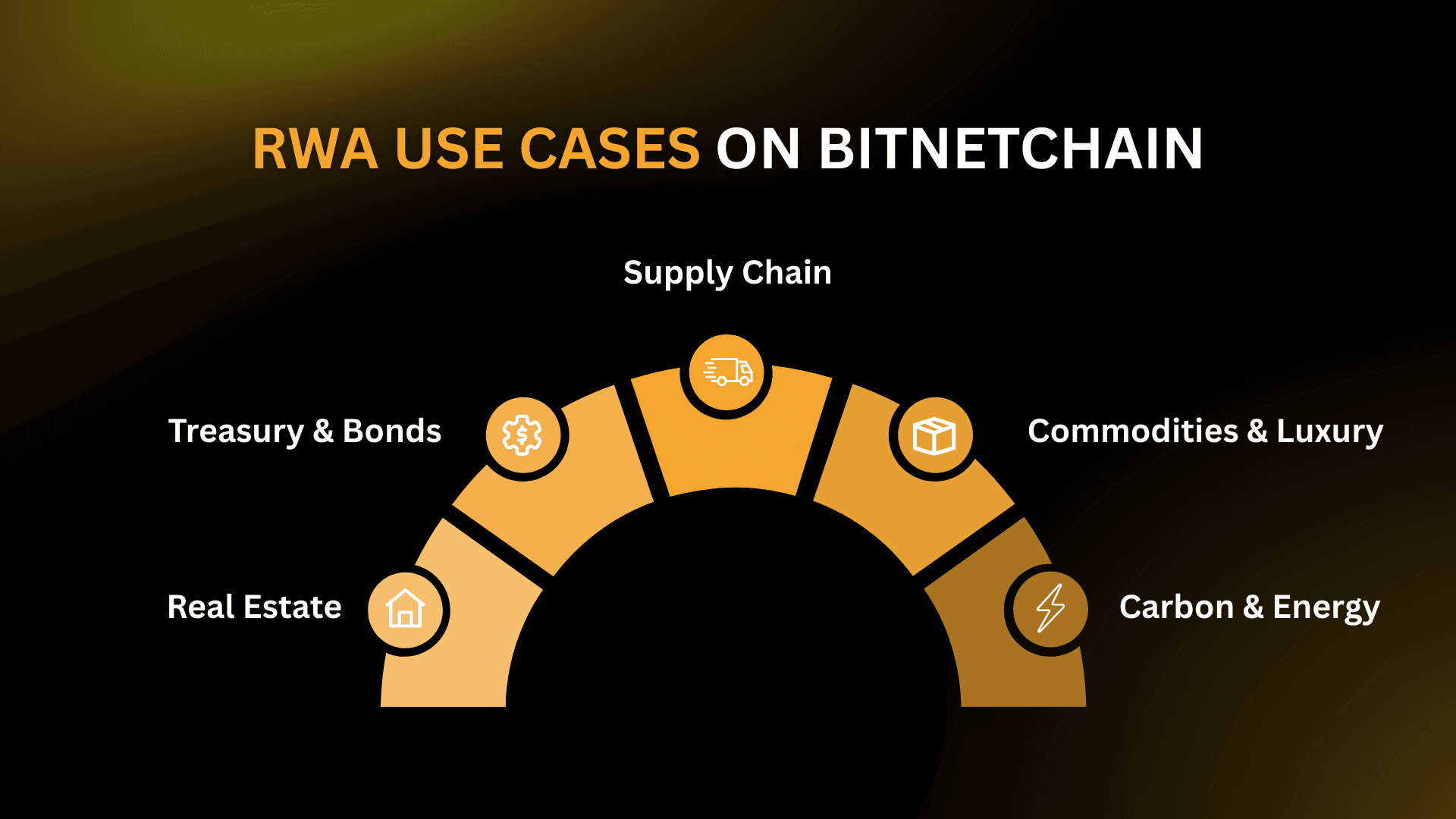
RWA Use Cases on BitNetChain
- Tokenized Real Estate: Fractional property ownership, automated rental payouts, and global investment participation.
- Treasury Bills and Bond Tokens: Programmable yield strategies and real-time settlement for conservative financial instruments.
- Supply Chain Assets: Tokenized invoices, receivables, and warehouse receipts support efficient financing and transparent audits.
- Commodities and Luxury Assets: Gold, diamonds, art, collectibles, and rare goods can be digitized with verifiable authenticity.
- Carbon Credits and Energy Assets: Tokenized carbon markets benefit from BitNetChain’s transparency and interoperability, supporting enterprise ESG programs.
7.8. How BitNetChain Reduces Operational Risks
BitNetChain minimizes operational risks by combining deterministic finality, decentralized validation, reliable data infrastructure, and flexible contract architectures. These capabilities enable RWA platforms to operate with predictable performance and institutional-grade security at scale.
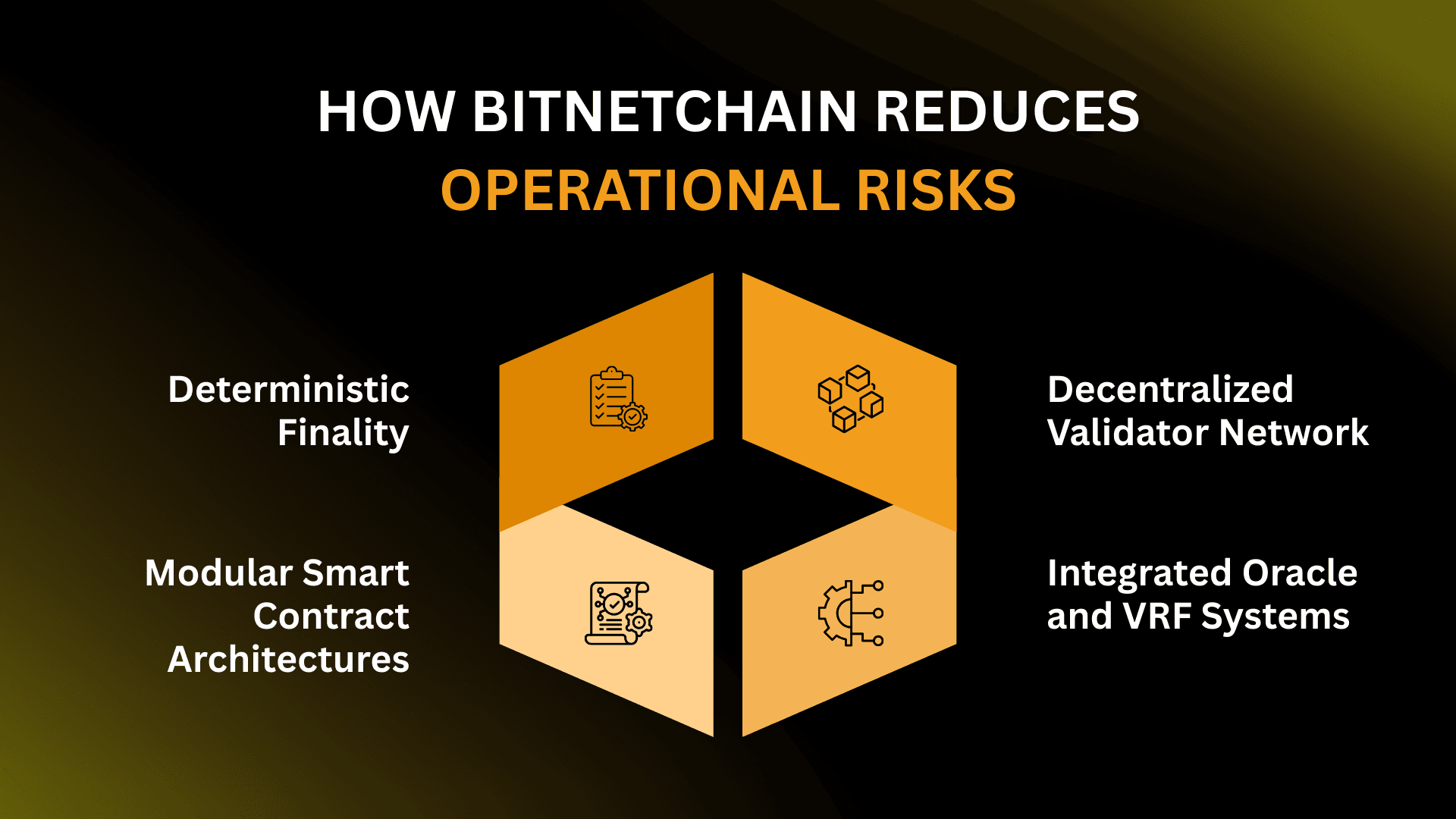
How BitNetChain Reduces Operational Risks
- Deterministic Finality: Ensures that transactions are irreversible and recognized by all participants instantly.
- Decentralized Validator Network: Strengthens network integrity and reduces dependence on centralized actors.
- Integrated Oracle and VRF Systems: Provide reliable data feeds and verifiable randomness for pricing, audits, and asset verification.
- Modular Smart Contract Architectures: Allow RWA issuers to upgrade asset logic, manage compliance workflows, and maintain regulatory alignment.
7.9. FAQ
Why use BitNetChain for RWA tokenization?
Because it combines high throughput, low fees, strong security, interoperability, and privacy modules in a single L1 optimized for both consumer and institutional use.
Does BitNetChain support compliant identity frameworks?
Yes. Its AI-DID module supports KYC, KYB, and verifiable credentials suitable for regulated asset markets.
Can RWA tokens move across chains?
Yes. IBC and the universal bridge allow cross-chain distribution to more than 110 blockchain ecosystems.
What programming environments are supported?
Both EVM and CosmWasm smart contract environments are supported, offering flexibility in development.
Are transactions private?
Developers may implement privacy using BitNetChain's zero-knowledge proof systems.
7.10. Conclusion
The tokenization of Real-World Assets is reshaping how value is stored, transferred, and accessed. BitNetChain provides the technical foundation needed to support this transformation by delivering high performance, low fees, robust security, and cross-chain interoperability. With identity, privacy, and compliance tools built in, BitNetChain empowers institutions and developers to bring real assets on-chain safely and at scale. As demand for programmable and globally accessible financial products continues to grow, BitNetChain stands as a powerful infrastructure for the next generation of RWA innovations.
Privacy with zk-SNARKs and zk-STARKs on BitNetChain
BitNetChain integrates advanced zero knowledge systems to secure sensitive data, protect user activity, and enable compliant privacy for real-world applications.
8.1. What You’ll Learn
- The fundamentals of zk-SNARKs and zk-STARKs
- Why privacy technologies are essential for modern blockchain ecosystems
- How BitNetChain implements zero knowledge proofs to balance transparency and compliance
- Key RWA, DeFi, and enterprise use cases enabled by private computation
- How developers can build privacy-first applications on BitNetChain
8.2. Why Privacy Matters on Blockchain
Transparency is a defining feature of public blockchains, but full visibility can expose sensitive financial data, identity information, and institutional activity. This creates challenges for enterprises, regulated markets, and real-world asset platforms that require confidentiality.
BitNetChain addresses these limitations through built-in support for zero knowledge proof systems that preserve privacy without compromising verifiability.
8.3. What Are zk-SNARKs and zk-STARKs?
8.3.1. zk-SNARKs
zk-SNARKs (Zero Knowledge Succinct Non-Interactive Arguments of Knowledge) allow one party to prove that a statement is true without revealing the underlying data. They are lightweight and efficient, which makes them suitable for applications requiring fast verification.
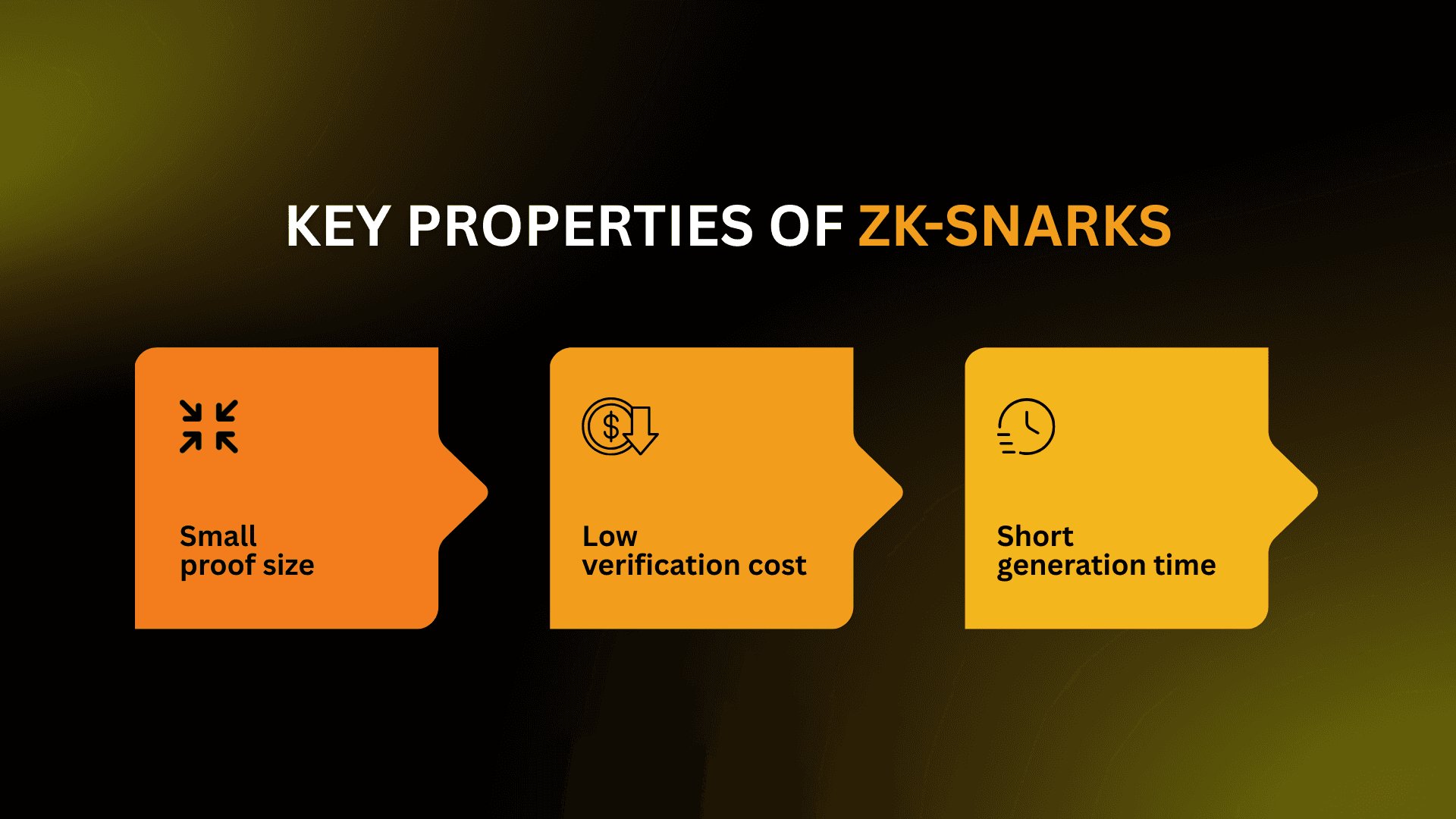
Key properties of zk-SNARKs
8.3.2. zk-STARKs
zk-STARKs (Zero Knowledge Scalable Transparent Arguments of Knowledge) provide transparency and scalability without needing trusted setup. They rely on hash-based cryptography and are resistant to quantum attacks.
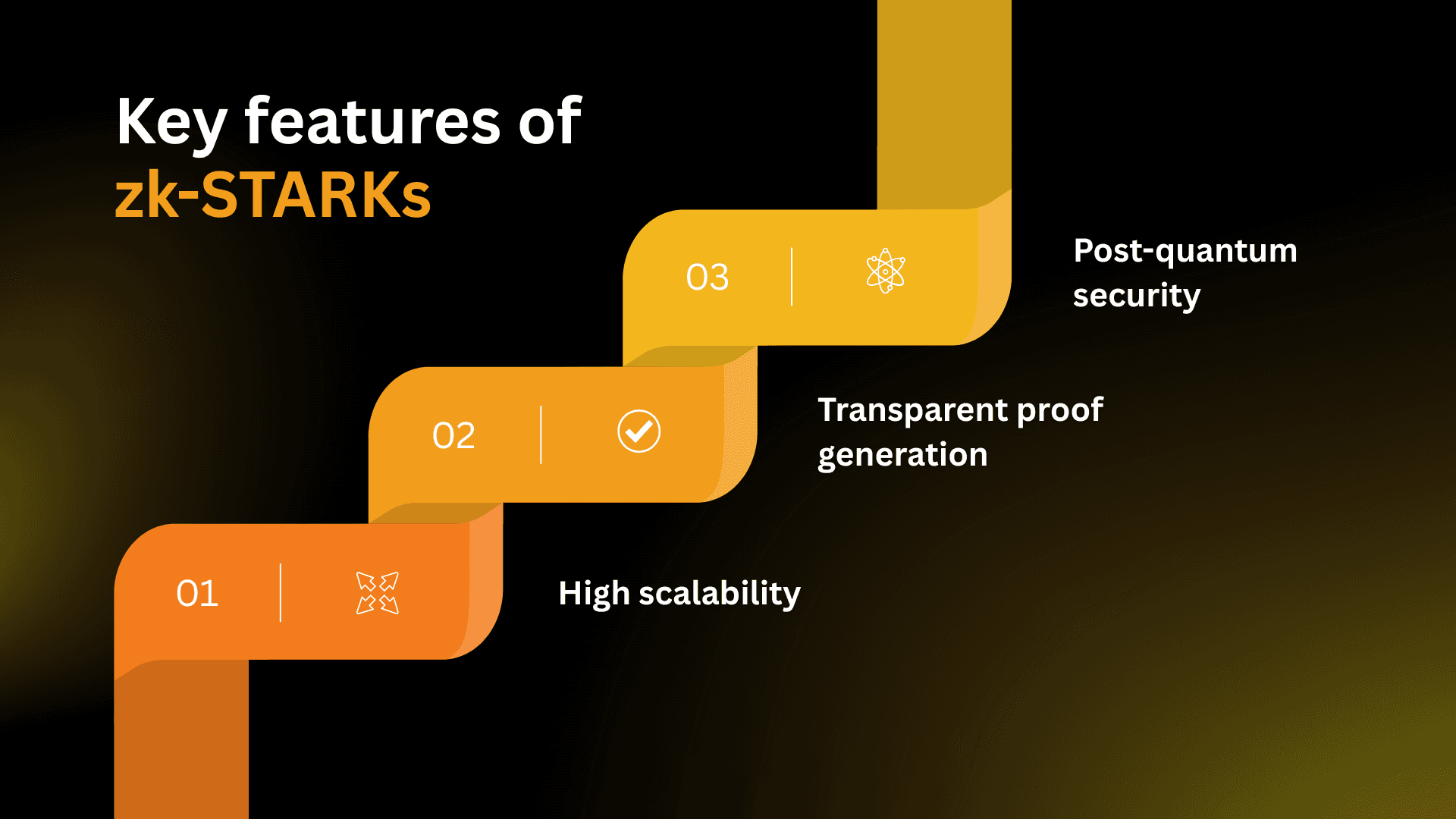
Key features of zk-STARKs
8.4. BitNetChain’s Approach to Zero Knowledge Privacy
BitNetChain integrates both zk-SNARKs and zk-STARKs to provide flexible privacy options for developers and institutions. This dual approach ensures that applications can choose the right proof system depending on performance requirements, trust assumptions, and regulatory needs. With these technologies, BitNetChain enables private computation, confidential transactions, and verifiable execution while maintaining the security guarantees of a public blockchain.
8.4.1. Privacy for Real-World Assets (RWA)
Privacy is essential for the tokenization of real-world assets, where sensitive data such as ownership, valuation, and corporate activity must be protected. BitNetChain leverages zero knowledge proofs to allow:
- Confidential asset transfers
- Hidden bid and settlement processes
- Permissioned access to asset data
- Compliance checks that reveal no private information
By integrating privacy at the protocol level, BitNetChain provides a secure environment for institutions bringing regulated assets on-chain.
8.4.2. Privacy in DeFi
Many DeFi applications require confidentiality for strategy execution, liquidity management, and user account protections. On BitNetChain, zero knowledge tools enable:
- Private swaps
- Confidential lending positions
- Shielded transaction histories
- Hidden MEV-sensitive operations
These features support a more secure and fair trading environment.
8.4.3. Enterprise Applications of Zero Knowledge Proofs
For enterprises, privacy is often a prerequisite for blockchain adoption. BitNetChain supports business needs through:
- Secure multi-party data sharing
- Confidential supply chain auditing
- Protected corporate governance
- Identity verification without data leakage
Zero knowledge technology lets enterprises operate in a transparent ecosystem while retaining control over sensitive information.
8.5. How BitNetChain Ensures Compliance with Privacy
Privacy on BitNetChain is engineered to operate within regulatory frameworks while preserving the confidentiality required by users, enterprises, and institutions. Zero knowledge proofs play a central role by allowing validators and auditors to verify the correctness of transactions and identity claims without revealing any underlying data. This enables essential compliance functions such as on-chain KYC, KYB, and credential verification to occur securely, supporting regulated activities without exposing sensitive information to the network.
In addition to enabling private verification, BitNetChain provides mechanisms for selective disclosure, allowing institutions to reveal only the data required for audits or regulatory checks. This approach ensures that organizations can satisfy compliance obligations while maintaining strict control over proprietary or personal information. By combining privacy with verifiability, BitNetChain creates a trustworthy environment for markets that must adhere to legal standards yet still benefit from blockchain transparency and decentralization.
8.6. Developer Benefits and Tools
BitNetChain offers developers a unified and flexible environment for building privacy-first applications through native support for both CosmWasm and EVM smart contracts. Integrated zero knowledge proof primitives simplify the implementation of confidential logic, reducing the need for external infrastructure or complex custom integrations. The chain’s high throughput, predictable execution, and low transaction fees further ensure that privacy-enhancing computations remain efficient and cost effective, even at scale.
Beyond its technical foundations, BitNetChain’s cross-chain interoperability allows private asset flows and secure data exchanges across multiple networks. This enables developers to create applications that function seamlessly within broader ecosystems while maintaining strong privacy guarantees. By combining robust tooling with scalable infrastructure, BitNetChain empowers teams to design advanced privacy solutions that meet enterprise, DeFi, and RWA requirements without compromising performance or regulatory readiness.
8.7. FAQ
Does BitNetChain support both zk-SNARKs and zk-STARKs?
Yes. BitNetChain integrates both systems to offer flexible privacy options for developers and enterprises.
Are private transactions compatible with auditors?
Zero knowledge proofs allow compliance verification without exposing sensitive information, enabling audit-ready privacy.
Can developers build fully private applications?
Developers can build confidential DeFi platforms, private RWA systems, and enterprise solutions using the network’s zero knowledge infrastructure.
Is BitNetChain’s privacy quantum resistant?
zk-STARKs used on BitNetChain provide post-quantum cryptographic security.
Does privacy affect transaction speed?
Zero knowledge proofs add computation but BitNetChain’s high throughput ensures efficient execution.
8.8. Conclusion
BitNetChain brings advanced privacy technology to a high performance Layer 1 environment. By supporting both zk-SNARKs and zk-STARKs, the network enables secure and compliant zero knowledge applications across DeFi, RWA, and enterprise use cases. With scalable infrastructure and low fees, BitNetChain empowers developers and institutions to build privacy-first solutions that protect sensitive data while maintaining transparency and trust.
Multi-VM Architecture on BitNetChain for Web3 Builders
BitNetChain introduces a Multi-VM architecture that gives Web3 developers a flexible execution environment with low fees and fast finality. It enables broader app design without sacrificing performance or security.
9.1. What You’ll Learn
- How Multi-VM Architecture works on BitNetChain
- Why EVM and CosmWasm support matters
- How execution, gas, and security differ across VMs
- What this architecture means for Web3 builders
9.2. What Is Multi-VM Architecture?
Multi-VM Architecture allows a blockchain to support several smart contract execution environments at once. BitNetChain uses this approach to run an EVM-equivalent environment and a CosmWasm environment inside a unified execution layer. Both VMs share the same consensus security, parallel execution engine, and deterministic state transitions, which creates a consistent and predictable development experience.
This structure allows developers to deploy Solidity-based or WASM-based contracts and migrate existing applications with ease. It also enables them to design new systems using the language and runtime that best fit their use case.
9.3. Why Is Multi-VM Architecture Important?
BitNetChain’s Multi-VM model removes the limitations of single-environment blockchains and expands what Web3 builders can create. Its importance becomes clear in several ways:
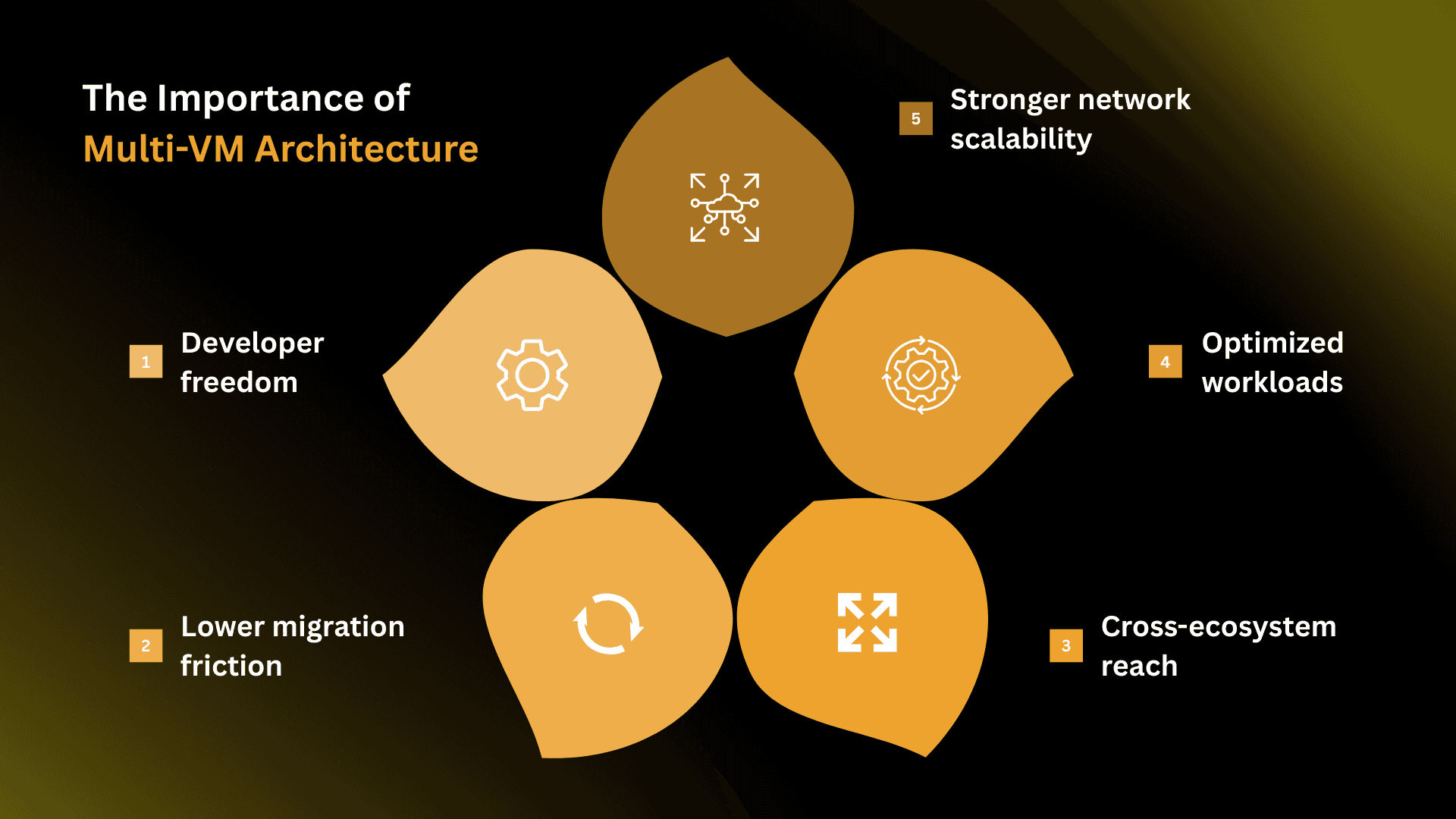
The Importance of Multi-VM Architecture
- Developer freedom: Teams can choose Solidity for EVM or Rust/Go for CosmWasm, depending on application needs.
- Lower migration friction: Ethereum-based projects can deploy without refactoring, speeding up adoption.
- Cross-ecosystem reach: EVM opens access to Ethereum tooling, while CosmWasm aligns with Cosmos SDK and IBC networks.
- Optimized workloads: Apps with complex logic or heavier computation can run more efficiently in WASM.
- Stronger network scalability: Multi-VM execution fits naturally within BitNetChain’s parallel processing and Dynamic Sharding, reducing bottlenecks at high loads.
This combination makes BitNetChain more adaptable than chains that rely on one execution environment and positions it as a foundation for multi-ecosystem development.
9.4. Architecture Overview
9.4.1. Unified Execution Layer with Integrated VM Capabilities
The Multi-VM system operates within a unified execution layer that handles routing, parallel processing, and finality. All transactions enter the same pipeline and are directed to the appropriate VM before execution. BitNetChain’s Parallel Execution Engine and Dynamic Sharding work together to scale workloads horizontally, enabling the network to exceed 50,000 TPS while maintaining sub-600 millisecond finality.
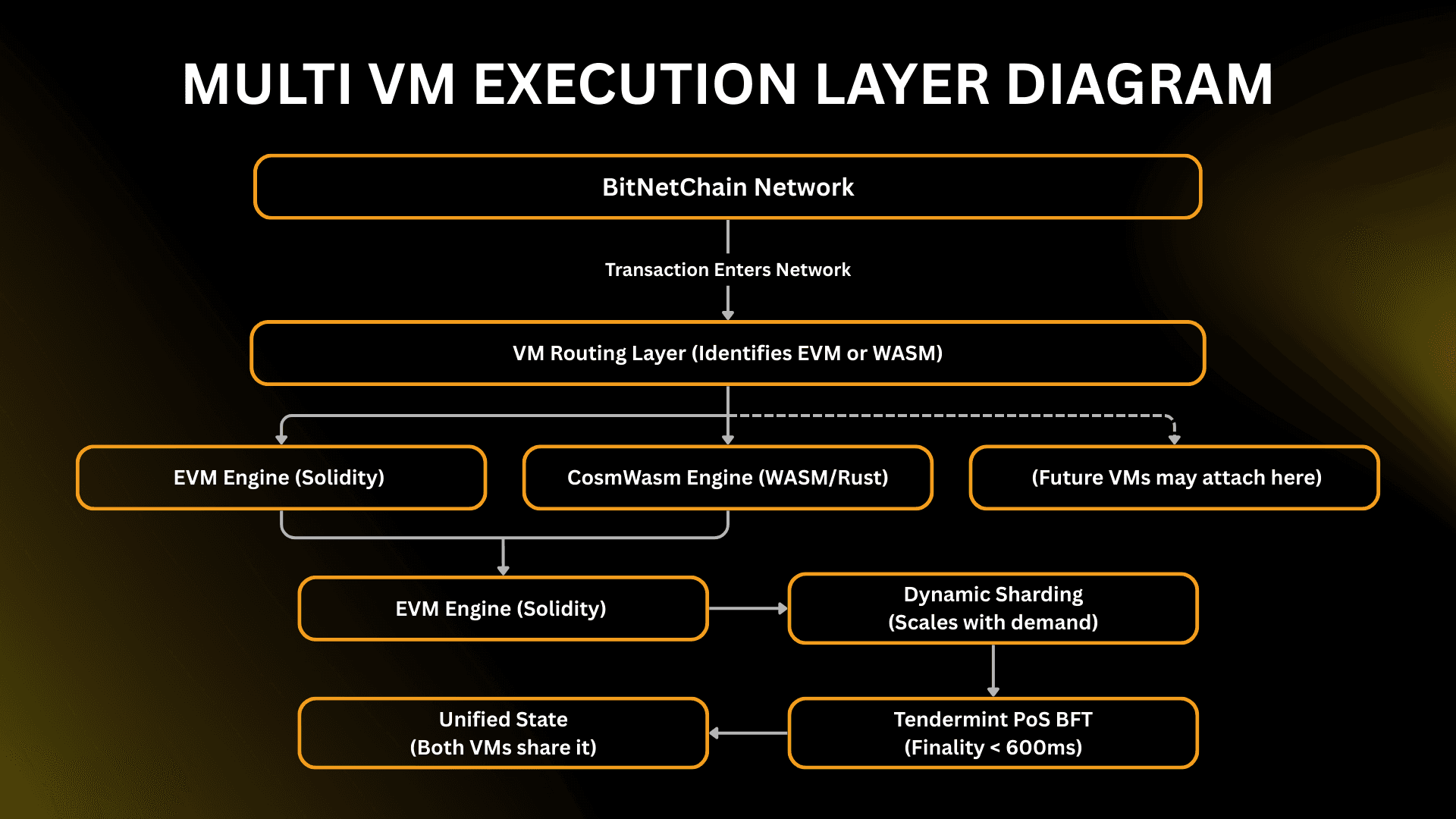
Multi-VM Execution Layer Diagram
This design ensures consistent performance across both VM environments and avoids the fragmentation seen on networks that treat VMs as independent modules.
9.4.2. How EVM and CosmWasm Differ Inside This Layer
Although both VMs share the same security and execution infrastructure, they serve different development preferences and application patterns. The table below summarizes their main characteristics within BitNetChain’s architecture:
By integrating this comparison directly into the execution architecture discussion, developers can better understand how both VMs complement each other within the same blockchain.
9.5. Performance, Gas, and Security Considerations
BitNetChain’s Multi-VM structure does more than provide flexibility; it enhances network performance and reliability. By running both VMs inside a parallelized and sharded execution environment, the architecture avoids congestion and keeps gas low regardless of application type. These benefits extend consistently across workloads, making the platform suitable for DeFi, gaming, identity systems, and high-frequency transactions.
9.5.1. Performance
BitNetChain processes transactions using a Parallel Execution Engine that evaluates multiple operations simultaneously. Dynamic Sharding adjusts network capacity based on observed demand, ensuring performance remains stable even during high activity. Both EVM and CosmWasm contracts gain equal access to this scalability model, allowing developers to build resource-intensive applications without worrying about throughput constraints.
9.5.2. Gas Efficiency
The network keeps gas costs under $0.00001 across both VM environments. Gas pricing remains stable because execution is distributed across shards and parallel lanes rather than competing for a single-threaded pipeline. This creates predictable operating costs for dApps that rely on frequent interactions or microtransactions.
9.5.3. Security Model
Security is maintained through Tendermint Proof of Stake with Byzantine Fault Tolerance. Validators confirm state updates from both VMs, ensuring consistent security guarantees. CosmWasm adds memory safety through WASM sandboxing, while EVM benefits from the maturity of its ecosystem and established auditing practices. Additional features such as zk-based privacy mechanisms and decentralized oracle systems further strengthen BitNetChain’s security posture.
9.6. FAQ
Can developers combine EVM and CosmWasm in a single application?
Yes. Both environments can be used together, enabling hybrid architectures.
Is it easy to migrate from Ethereum?
Yes. BitNetChain’s EVM is fully compatible, allowing most contracts to deploy without code changes.
Do the two VMs share the same state?
They operate within a unified state machine, ensuring predictable interaction across environments.
Can more VMs be added later?
Yes. The architecture is designed to accommodate additional environments in future upgrades.
9.7. Conclusion
BitNetChain’s Multi-VM Architecture offers a practical and scalable approach for Web3 builders who want flexibility without losing speed or security. By unifying EVM and CosmWasm execution in a single high-performance framework, the network enables developers to choose the right tools, design more advanced applications, and deploy across ecosystems with minimal friction. This model supports the broader shift toward interoperable and efficient Web3 infrastructure, providing a foundation for next-generation decentralized applications.
BitNetChain Roadmap for a Scalable and Interoperable Future
BitNetChain is building a high performance blockchain designed for global scale and seamless cross chain interaction. Its roadmap outlines how the network will evolve into a unified foundation for Web3.
10.1. Why the BitNet Roadmap Matters
A strategic roadmap provides clarity on how BitNetChain will address the major limitations seen across current Layer 1 networks. Scalability, interoperability, low fees, and developer flexibility are essential for real world blockchain adoption, yet many existing platforms struggle to deliver all of these benefits together. BitNetChain’s roadmap matters because it presents a structured path toward a network that can support enterprise grade systems, high volume DeFi activity, and global financial infrastructure.
The roadmap also reflects BitNetChain’s commitment to long term sustainability. This includes a focus on predictable economics, efficient execution layers, privacy options, user oriented features, and partnerships across sectors. As the blockchain industry matures, ecosystems that combine high throughput, cost efficiency, and interoperability are best positioned to lead. BitNetChain’s roadmap shows how these capabilities will be built step by step.
10.2. Our Vision and Mission
BitNetChain envisions a decentralized future where applications can run at high speed, communicate across multiple chains, and provide secure digital services for people worldwide. Its mission is to deliver a Layer 1 network that solves the challenges of congestion, fragmentation, and poor user experience that affect many blockchains today.
The platform is built on several guiding principles drawn from the whitepaper. BitNetChain prioritizes scalability through a parallel execution engine and dynamic sharding so the network can process thousands of transactions per second. It ensures security through Tendermint Proof of Stake with Byzantine Fault Tolerance, enabling rapid finality. It commits to low transaction fees to support microtransactions and mass market applications. It fosters interoperability through native IBC support and a universal bridge that connects to a wide range of blockchain ecosystems. It also supports developers with a multi VM environment that includes both EVM and CosmWasm for full flexibility.
Together, these principles guide the roadmap and ensure that each phase strengthens the foundations needed for a global decentralized protocol.
10.3. BitNetChain Roadmap Detail
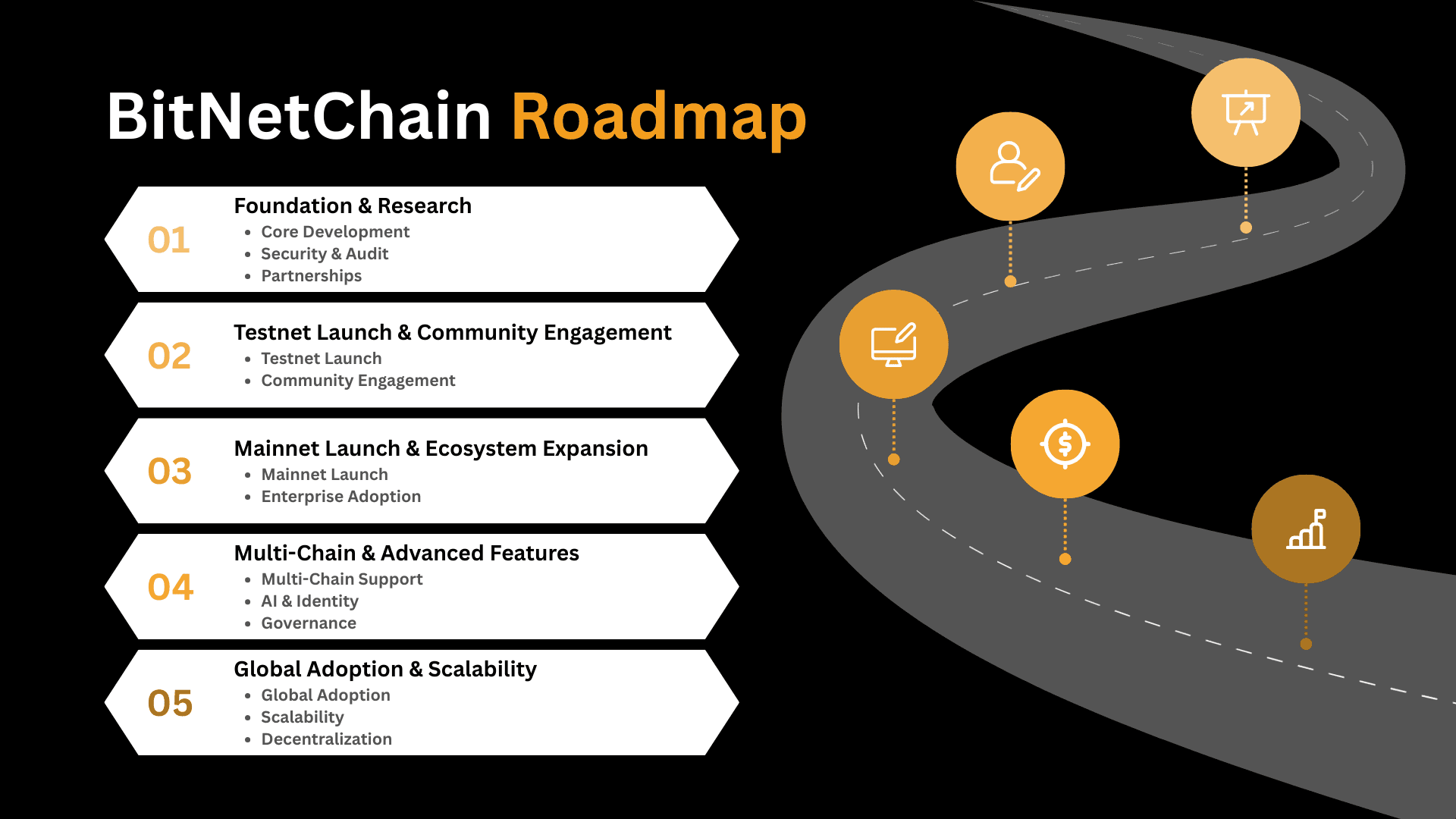
BitNetChain Roadmap
Phase 1: Foundation and Research
The first phase focuses on building the fundamental architecture that defines BitNetChain. This includes extensive research into execution layers, consensus optimization, and sharding. During this phase, the team refines the technical model for high throughput, low cost performance, and cross chain communication. Key components such as the multi VM architecture, the parallel execution engine, and Tendermint based Proof of Stake are designed and validated.
This foundational work ensures that BitNetChain can scale without compromising decentralization or security. It also establishes the principles that guide all later stages, such as user centric account abstraction, privacy features, and developer support.
Phase 2: Testnet and Community Expansion
The second phase introduces a public testnet that allows developers, validators, and partners to test the network in a live environment. This phase focuses on improving network stability, testing throughput under real conditions, evaluating VM compatibility, and validating the interoperability layer.
Community expansion also becomes central in this stage. BitNetChain encourages early participation through testing initiatives, educational programs, developer tooling, and onboarding support. This ensures that builders and ecosystem partners can begin deploying smart contracts, testing applications, and preparing future services on the platform.
Phase 3: Mainnet and Ecosystem Expansion
The third phase brings BitNetChain into full production with the launch of its mainnet. This phase activates the full capabilities of the network, including multi VM support, parallel execution, sub second finality, and ultra low transaction fees. The mainnet launch also supports the rollout of governance, staking, and validator operations that secure the network.
Ecosystem expansion becomes a primary objective. This phase attracts DeFi protocols, cross chain projects, consumer applications, enterprise use cases, and Web3 services that benefit from cost efficiency and scalability. The universal bridge and IBC integration enable developers to bring assets and liquidity from other networks, strengthening BitNetChain’s position as an interoperable hub.
Phase 4: Multi Chain Integration and Advanced Features
At this stage, BitNetChain evolves into a fully interconnected network that supports seamless communication across numerous chains. The universal bridge reaches broader compatibility, enabling transfers and messaging across more than one hundred networks. This phase also enhances performance with additional execution optimizations and improved sharding strategies to support increasing transaction volumes.
Advanced features such as enhanced privacy layers using zk based proofs, decentralized identity systems, cross chain DeFi infrastructure, and new modular services are expanded. Developers gain access to more SDKs and APIs that simplify multi chain application design. This phase strengthens BitNetChain as a core infrastructure layer for Web3 and real world applications.
Phase 5: Global Adoption and Scaling the Network
The final phase aims to position BitNetChain as a globally adopted blockchain infrastructure. With a mature ecosystem, strong liquidity, and cross chain connectivity, the network focuses on large scale integration across financial systems, enterprises, and global markets. Transaction capacity continues to scale through dynamic sharding, while fees remain extremely low to support mass adoption.
This phase also expands decentralization by increasing validator participation and strengthening governance. As decentralized applications mature, BitNetChain becomes a foundation for digital identity, cross border financial services, decentralized commerce, and global Web3 ecosystems. The mission is to provide accessible, secure, and efficient blockchain services for users around the world.
10.4. FAQ
Why does BitNetChain use a phased roadmap?
A phased roadmap ensures the network grows sustainably, with each stage building on a secure and well tested foundation.
How does BitNetChain plan to support developers?
Developers benefit from EVM and CosmWasm support, low fees, fast finality, extensive SDKs, and strong interoperability across multiple chains.
What role does interoperability play in the roadmap?
Interoperability is central at every stage. BitNetChain integrates IBC and a universal bridge that connects more than one hundred blockchains, enabling cross chain liquidity and application design.
Will BitNetChain scale as adoption increases?
Yes. The network uses a parallel execution engine and dynamic sharding, allowing it to scale transaction capacity based on demand without affecting decentralization.
10.5. Conclusion
BitNetChain’s roadmap presents a clear and strategic path toward a scalable, interoperable, and developer friendly Layer 1 network. Each phase focuses on strengthening performance, improving user experience, expanding ecosystem potential, and advancing cross chain capabilities. By combining multi VM execution, low fees, fast finality, and a long term vision for global adoption, BitNetChain is positioned to support the next generation of decentralized applications and digital infrastructure.
CHAPTERS
BitNetChain Basics
1. What is BitNetChain?
CHAPTERS
A Layer 1 blockchain for scalable, secure, and programmable networks.


