
Parallel Execution at Scale
Parallel
Execution at Scale
Process tens of thousands of transactions in parallel with sub-second, deterministic finality and ultra-low fees.

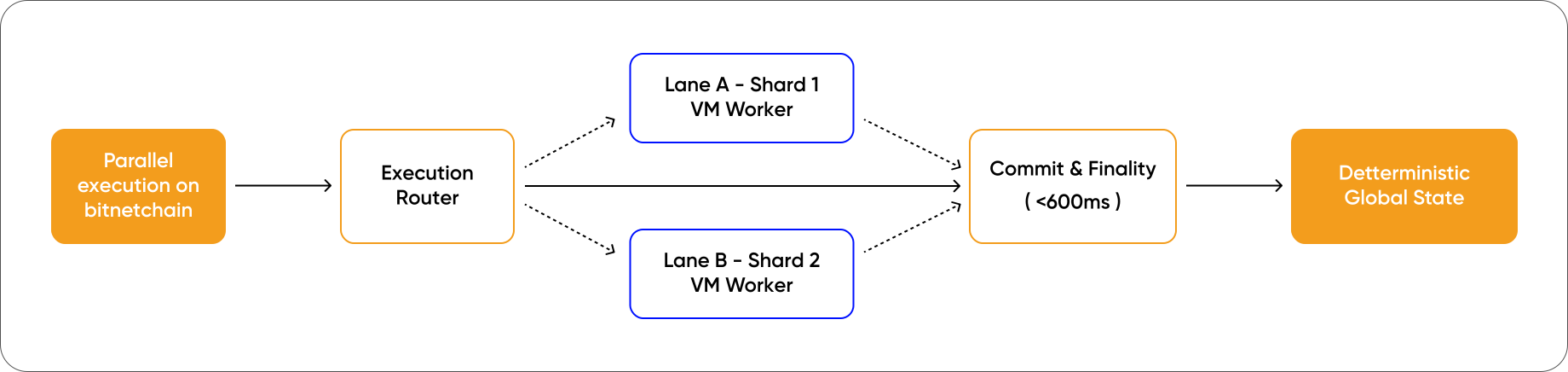
Group transactions by access patterns, contention level, and VM type.

Distribute lanes across shards so hot spots don’t slow the entire chain.

Track read/write sets, detect collisions, and retry only conflicting transactions.

Merge shard outputs into one final state under BFT-secured consensus.




How do DEXs and DeFi protocols take advantage of parallel execution?
DEXs and DeFi protocols can structure pools, markets, and positions so most trades touch separate state (different pools, accounts, or orderbooks). That allows many swaps, liquidations, and rebalances to settle in parallel, while only truly conflicting operations fall back to more sequential handling.
Do I need to design my smart contracts differently to benefit from parallel execution?
You don’t need a completely new mental model, but you get better results if you minimise shared “hot” state. Patterns like per-pool storage, per-market state, and clear separation between independent components make it easier for the engine to run your transactions in parallel.
Does parallel execution change how final ordering looks to users?
Internally, the engine may execute transactions in different parallel lanes, but the block still has a single canonical order and a single final state. From a user or dApp perspective, you interact with one consistent history, not multiple competing timelines.
Is there a limit on the number of lanes and shards?
There are protocol-level limits for practicality and validator performance, but the engine is designed so the network can add or rebalance lanes and shards as demand grows. In practice, governance and node capabilities define the upper bounds, while the architecture lets BitNetChain scale horizontally over time.
What happens when many transactions hit the same pool or account?
In that case, the engine treats that area of state more like a sequential lane: conflicting transactions are retried in a safe order, while unrelated lanes continue in parallel. Worst case, that specific hotspot behaves like a traditional single-threaded path, but it doesn’t drag down the rest of the network.
Does this affect both EVM and CosmWasm workloads?
Yes. Parallel execution spans BitNetChain’s multi-VM environment: EVM-equivalent and CosmWasm contracts can be scheduled across lanes and shards, while the engine coordinates dependencies and state so everything settles into one coherent result.
A Layer 1 blockchain for scalable, secure, and programmable networks.


